
Which Cat Water Fountain Features Actually Matter for Hydration and Cleanup?
The best cat water fountain is not necessarily the smartest or most expensive. Look for a flow your cat will tolerate, parts you can reach and wash, and filters and pumps you can replace when they wear out.
On this page
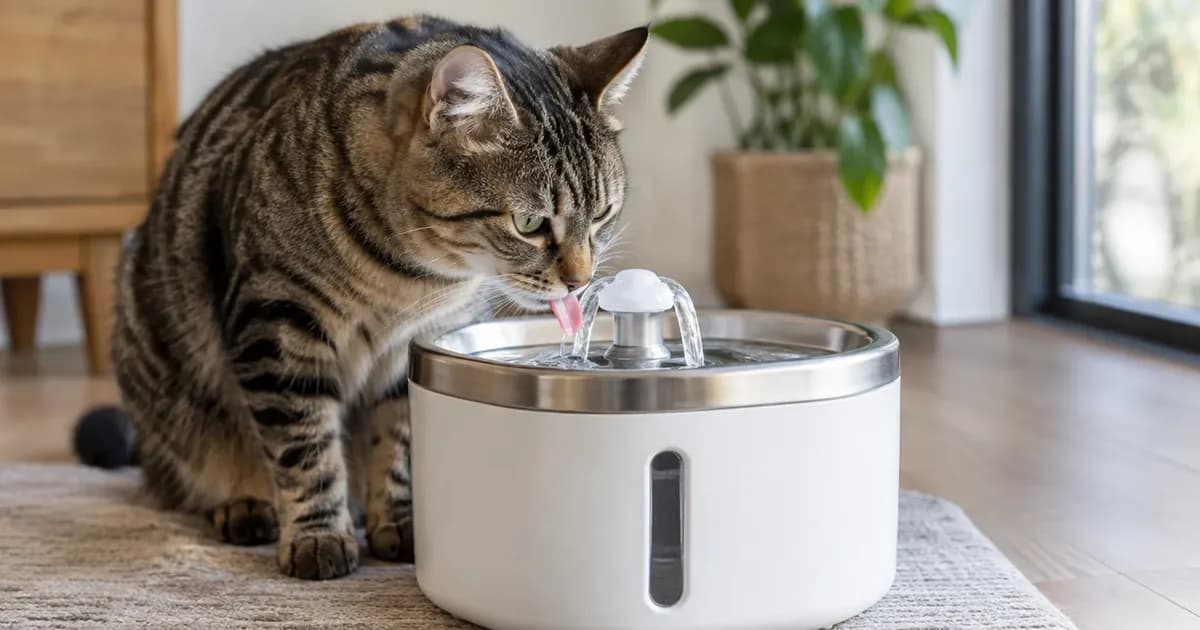
A cat water fountain can be useful, but it isn't a guaranteed hydration upgrade. Research has found large individual differences in cats' preferences and no conclusive evidence that fountains reliably increase water intake compared with bowls. Some cats do seem drawn to moving water, particularly cats that already seek out a faucet or shower. https://academy.royalcanin.com/en/veterinary/the-water-requirements-and-drinking-habits-of-cats
That makes the buying question more practical than promotional: Will your cat accept the flow, and can you keep the whole thing genuinely clean? A fountain that looks impressive but is awkward to dismantle may become a neglected water bowl with a motor attached.
Start with the cat, not the feature list
Moving water matters only if your cat likes moving water. A quiet stream, a bubbling surface, or a gentle trickle may appeal to one cat and unsettle another. Some cats prefer still water, while others investigate running taps. The supplied evidence supports individual preference, not the idea that cats universally prefer fountains. https://icatcare.org/resources/cat-carer-guide-encouraging-your-cat-to-drink.pdf
Flow adjustment is therefore more useful than a single “powerful” setting. A pump with adjustable speed or interchangeable flow pieces gives you room to experiment without replacing the entire fountain. Start gently, especially if the cat is cautious around noise or splashing.
Noise deserves similar attention. A hum that seems minor in a shop or product video may become irritating in a quiet room, and a nervous cat may avoid a fountain that vibrates or splashes. Place it away from litter boxes and busy walkways, where the cat can drink without feeling cornered. Introduce a new fountain gradually rather than removing every familiar bowl at once. https://icatcare.org/resources/cat-carer-guide-encouraging-your-cat-to-drink.pdf
For readers interested in how strongly water preferences can vary, this guide to cat breeds that like water offers useful context—but breed is not a guarantee of an individual cat's response.
Cleanup is the feature that matters most
A fountain's maintenance loop is more consequential than its app, light, or water-level alert. Water touches the reservoir, drinking surface, filter, tubing, and pump. Each part needs to be accessible enough that you can inspect and wash it rather than cleaning only the visible bowl.
Before buying, check whether:
- The reservoir comes apart without special tools.
- The pump can be removed and opened.
- The impeller and small internal channels are reachable.
- There are no deep, narrow cavities that trap hair or food.
- The drinking surface can be scrubbed separately.
- The manufacturer provides clear cleaning instructions.
The pump deserves particular attention. Hair, food particles, mineral deposits, and other debris can collect around the impeller, reducing flow and making the fountain noisier. Guidance from fountain manufacturers commonly recommends regular pump disassembly, while independent care guidance also stresses that filters do not replace washing the reservoir and pump. https://pioneerpet.com/instructions/frequently-asked-questions/ https://www.webvet.com/best-cat-water-fountains/
Fresh water is not the same as continuously circulating water. A fountain still needs regular disassembly and cleaning, and water should be refreshed routinely. International Cat Care advises regular cleaning and says fountains should be thoroughly disassembled, with filters changed according to the manufacturer's instructions. https://icatcare.org/resources/cat-carer-guide-encouraging-your-cat-to-drink.pdf
Filters are consumables, not a maintenance plan
Filtration is commonly marketed as a way to keep water fresher and remove debris or odors. That may be useful, but filter systems differ, and the supplied evidence does not establish that every filter delivers the same result. More importantly, a filter cannot remove the need to wash the fountain.
Look for a model whose replacement filters are easy to identify and likely to remain available. A proprietary cartridge that is difficult to find can turn a convenient fountain into an expensive paperweight. Owners also repeatedly focus on the availability of pump parts and filters over the product's usable life.
Replacement timing depends on the design, water quality, debris, shedding, and the number of animals using the fountain. Manufacturer guidance commonly falls in the range of roughly two to four weeks, but the product instructions should take priority. https://pioneerpet.com/instructions/frequently-asked-questions/ https://www.webvet.com/best-cat-water-fountains/
Treat claims about bacterial control carefully. Continuous circulation alone has not been verified as a guarantee of hygienic water, and the supplied research does not verify that a fountain's filtration system prevents disease or reliably reduces bacterial growth. Cleaning remains the owner's responsibility.
Capacity should fit your household
A large reservoir can reduce refill frequency, but “bigger” is not automatically better. Match capacity to the number of cats sharing the fountain and to how often you can realistically refresh the water. A single cat in a quiet home may not need the same reservoir as several cats sharing one station.
A larger tank can also make cleaning more cumbersome if it is heavy, awkward to empty, or difficult to fit under a tap. Capacity is useful only when the rest of the design remains manageable. A smaller, accessible fountain that gets refreshed and washed reliably may serve better than a large model that is left untouched for too long.
Materials: preference, not proof
Stainless steel and ceramic are commonly preferred by some owners because they feel easier to keep clean than plastic. That is a reasonable buying preference, but the supplied evidence does not establish that either material improves hydration, prevents feline acne, or protects against urinary disease. No bowl material should be treated as a medical solution. https://www.webvet.com/best-cat-water-fountains/
Choose a material that is smooth, durable, and practical to wash. Also inspect the underside, seams, rubber feet, and any decorative channels. A premium bowl surface does not compensate for a pump housing full of inaccessible corners.
Features that sound impressive but need perspective
Smart connectivity, sensors, lights, and app notifications may help some owners notice an empty reservoir or irregular use. The supplied research does not show that these features improve hydration outcomes. They are conveniences, not evidence that the fountain will make a reluctant cat drink.
Similarly, a fountain should not be sold to you as protection against kidney disease, urinary disease, or urinary crystals. Better access to water may be part of a veterinarian's broader advice for an individual cat, but a fountain is not a substitute for diagnosis, treatment, or follow-up. A noticeable change in drinking, urination, appetite, or energy warrants veterinary advice rather than a gadget upgrade.
A sensible pre-purchase checklist
Before ordering, ask:
- Does my cat already show interest in running or moving water?
- Can the flow be made quieter or gentler?
- Is every wet component removable and washable?
- Can I reach the pump impeller and internal channels?
- Are replacement filters clearly available?
- Can I buy a replacement pump or other vulnerable parts?
- Does the capacity suit the number of cats and my refill routine?
- Will the fountain fit in a calm, accessible location?
- Do the cleaning instructions seem realistic for ordinary life?
The most useful fountain is usually the one that survives this checklist with the fewest compromises. Hydration depends first on whether the cat actually drinks from it; hygiene depends on whether the owner can keep every part clean. Novelty may attract attention, but accessible parts, manageable noise, reliable replacement supplies, and a tolerable flow are what make a fountain worth living with.
FAQ
Sources
- Cat water fountain recommendations? : r/BuyItForLife - Reddit — owner discussion