
How Can You Compare Dog Food Ingredients Without Falling for ‘Natural’ Marketing?
Dog food labels answer different questions, and the front of the bag usually answers the least useful one. Here’s a practical way to compare adequacy, product names, ingredient order, moisture, nutrients, and feeding directions without letting marketing do the thinking for you.
On this page
The front of a dog-food bag is designed to make a promise. The back has to explain what the food actually is.
That distinction gives you a useful shopping method: start with the nutritional adequacy statement, then check the product name, ingredient list, guaranteed analysis, and feeding directions. Only after that should words such as natural, premium, holistic, or grain-free enter the conversation. Those terms may describe how a food is presented, but they don't replace evidence about whether it is complete, appropriate, and nutritionally comparable.
Start with the information panel
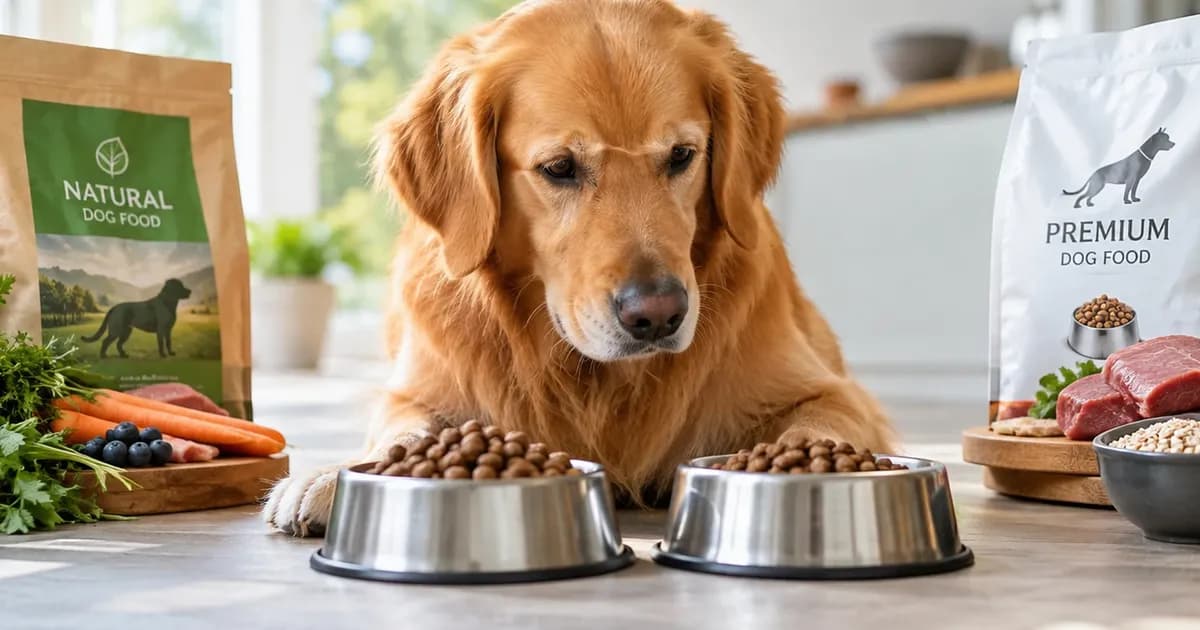
A cheerful photograph of chicken, vegetables, or a romping dog can help you recognize a product, but it cannot tell you whether the food is intended as a sole diet or how its nutrients compare with another formula. The information panel contains the details that make comparison possible: the ingredient list, guaranteed analysis, feeding directions, and regulatory or nutritional statements.
That is also where you can separate a complete food from a complementary product. A complete-and-balanced statement indicates that the food is intended to meet nutrient requirements for a stated life stage or use. In UK and European labeling, a food described as complete is intended to meet dietary needs when fed alone, while complementary food is meant to be fed alongside other food.
A food can look substantial and carefully made while still being unsuitable as the only thing in your dog's bowl. Check this statement before judging the ingredients.
For a closer look at label terminology, this guide to reading dog food labels can help you work through the information panel line by line.
Read the product name more carefully than the picture
Product names are not all making the same promise. The wording can indicate how much of a named ingredient the food must contain under the supplied labeling rules:
- An unqualified named ingredient, such as a food identified simply with beef, follows a 95% rule for the named ingredient or ingredients, excluding water, under the described convention.
- Words such as dinner, entrée, or platter use a 25% rule for the named ingredient or ingredients, excluding water.
- With chicken or similar wording uses a 3% rule.
- Chicken flavor does not state the same minimum percentage requirement for chicken.
So “chicken dinner” does not mean the food is mostly chicken, and “with beef” is not equivalent to a food named simply for beef. The wording is a prompt to inspect the full label, not a shortcut around it.
Ingredient order tells you weight, not the whole nutritional story
Ingredients are listed in descending order by weight before cooking or processing. That sounds straightforward until water enters the picture.
Fresh meat contains a substantial amount of water. It can therefore appear near the top of an ingredient list even though much of that water is lost during cooking. Meat meal has already had water and some fat removed, making it a more concentrated ingredient. A meal listed below fresh meat may contribute more protein to the finished food than its position suggests.
Ingredient splitting can complicate the list further. Several forms of a carbohydrate ingredient may appear separately and therefore lower down, even though their combined contribution may be considerable.
None of this makes fresh meat bad, or meal automatically better. It means ingredient order cannot establish nutritional quality, digestibility, nutrient availability, or suitability for an individual dog on its own. Dogs require nutrients, not a particular-looking ingredient list, and two foods with similar lists can still differ nutritionally.
Convert the guaranteed analysis before comparing foods
The guaranteed analysis commonly gives minimum crude protein and crude fat, plus maximum moisture and crude fiber, on an as-fed basis. That is the food as it sits in the package, including its water.
Comparing those percentages directly can produce a misleading result, particularly when one food is canned or otherwise high in moisture and the other is dry kibble. Convert each nutrient to a dry-matter basis first:
`Dry-matter nutrient percentage = as-fed nutrient percentage ÷ (100 − moisture percentage) × 100`
For example, a food labeled with 8% protein and 78% moisture has about 36% protein on a dry-matter basis:
`8 ÷ (100 − 78) × 100 ≈ 36%`
A food labeled with 26% protein and 10% moisture has about 29% protein on a dry-matter basis:
`26 ÷ (100 − 10) × 100 ≈ 29%`
The food with the lower number on the package therefore has the higher calculated protein percentage once water is removed. The same approach can be used for fat, although the guaranteed analysis provides minimums and maximums rather than a complete picture of every nutrient.
Dry-matter comparisons are useful, but they still don't answer every feeding question. Calories, portion size, life stage, and a dog's individual health also matter. A label comparison is a screening tool, not a diagnosis or a substitute for veterinary nutritional advice.
Treat marketing words as questions
Words such as natural, premium, holistic, wholesome, ancestral, and grain-free can influence the way a food feels before you have examined its evidence. The supplied material does not establish that these terms, by themselves, prove superior nutrition, complete nutrition, better digestibility, or better suitability for your dog.
A more useful response is to turn each word into a question:
- Natural: What does the label say about nutritional adequacy and ingredients?
- Premium: What measurable difference separates this food from the alternative?
- Holistic: Is there a specific, verifiable nutritional claim behind the word?
- Grain-free: Does your dog actually need this formulation, and what ingredients replace the grains?
- With real meat: What does the product name require, and where does the named meat appear in the complete list?
Price and packaging deserve the same treatment. The available evidence does not show that a higher price, attractive design, or premium-sounding label reliably predicts better nutrition.
A practical two-label comparison
Place both packages side by side and work through them in this order:
- Check the intended use. Confirm that each food is complete, balanced, or otherwise intended for the same purpose.
- Match the life stage. Puppy, adult, reproduction, and other designations are not interchangeable.
- Read the product names. Look for dinner, with, or flavor wording before assuming how much of a named ingredient the food contains.
- Record moisture and guaranteed-analysis values. Convert protein and fat to dry matter when moisture levels differ.
- Read the entire ingredient list. Look beyond the first ingredient, noting fresh meat, meals, and potentially split carbohydrate ingredients.
- Check feeding directions. Compare the recommended amount for your dog's weight and life stage, rather than comparing bag prices alone.
- Look for information the label does not provide. Ingredient order alone cannot tell you whether a food suits a dog with a medical condition, suspected intolerance, or unusual nutritional requirement.
This process is less dramatic than hunting for a single “good” or “bad” ingredient, but it is much harder for a front-panel slogan to derail.
For broader comparisons of pet products, the dog food and pet product comparison section is a natural next stop. And if your dog has recurring digestive problems, a label checklist should sit alongside—not replace—advice about choosing a gentler formula for sensitive stomachs.
Keep owner anecdotes in their proper place
Dog owners often share useful observations: a food their dog accepts, a formula that seemed easier to feed, or a label claim they found confusing. Those experiences can suggest questions worth investigating, but they do not establish nutritional or regulatory facts. A forum post cannot prove that an ingredient is harmful, that a food is complete, or that one manufacturing approach is superior.
For a healthy dog, use the label to establish what the food is intended to provide and to make sensible comparisons. For a dog with a medical diet, suspected food intolerance, or persistent symptoms, ask a veterinarian for individualized guidance rather than trying to solve the problem through marketing language or ingredient-list guesswork.
A good label comparison does not identify one magic ingredient. It reveals what each part of the package can—and cannot—tell you. Once you start with adequacy, translate the product name, adjust for moisture, and read the full list in context, “natural” becomes what it should have been all along: a prompt to look closer, not a reason to stop looking.