
Harness or Collar: Which Choice Helps a Dog Learn Without Adding Confusion?
A collar and a harness can both be useful during dog training, but neither teaches loose-leash walking on its own. The most helpful choice is the one that manages safety and comfort while you keep the leash rules, cues, and rewards consistent.
On this page
A collar or harness can both be sensible choices for training. The right answer depends less on which item is supposedly best and more on what your dog needs from it: safe control, a comfortable fit, and a clear, repeatable connection between your leash cues and the behavior you reward.
A piece of equipment can help you manage a walk. It cannot teach a dog that a loose leash is the goal. That learning still comes from practice and reinforcement.
Start with the dog in front of you
For a puppy just beginning leash training, a standard collar may be a reasonable starting point. The American Kennel Club describes a standard dog collar as a suitable choice for puppies learning to walk on leash, and collars are lightweight and convenient for identification tags.
A collar may also suit a calm dog that rarely pulls and does not try to back out of its equipment. Depending on the dog's size and the handler's strength, a collar can provide more direct control with less physical effort.
The picture changes when a dog regularly surges forward, lunges, or is difficult to hold safely. A harness may be more comfortable for a dog that tugs because it can distribute pressure across the chest and shoulders rather than concentrating it around the neck.
That does not make a harness a cure for pulling. A dog can pull into a harness quite enthusiastically. The harness may make management safer or more comfortable while you teach the walking behavior itself.
Dogs that can slip out of a collar also deserve special attention. A loose collar is an escape risk, particularly for dogs whose heads are narrower than their necks, including Greyhounds and Whippets. In that situation, a properly fitted harness—or another carefully selected secure setup—may be the more practical management choice.
There is no reliable evidence in the supplied material showing that collars or harnesses produce better learning outcomes overall. Claims that one option is essential for every puppy, puller, or short-nosed breed go beyond what these sources establish.
Fit comes before training
Poor fit can turn otherwise ordinary equipment into a safety problem or a source of discomfort. A collar should be snug without pressing into the skin. The AKC's basic check is one finger between the collar and the skin for a small dog, or two fingers for a large dog.
A collar should also stay secure when the dog moves, turns, and lowers its head. If it can slide over the head, the fit is not doing its job. Check this especially carefully with dogs whose neck and head shapes make slipping out easier.
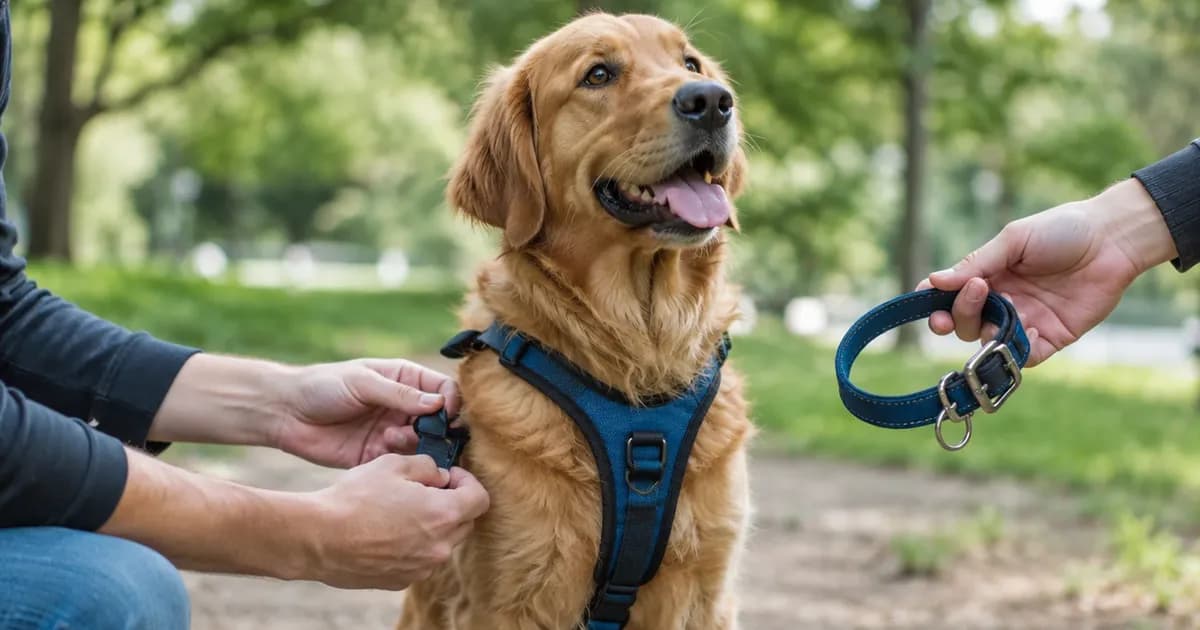
Harnesses need the same care. The straps should be snug but not pinching, and a poorly fitted harness may cause rubbing or chafing. Check the fit while your dog is standing and moving rather than judging it only while the dog is still. The harness should not restrict ordinary walking or leave enough space for the dog to wriggle free.
If your dog dislikes having a harness put on, introduce it gradually. Let the dog investigate it, reward calm attention, and build toward wearing it in small steps. Equipment that starts every walk with a struggle can become part of the problem before training even begins.
Can you use both?
Yes, but give each piece a predictable job. For example, a collar might carry identification tags while a harness is used for walks, or a collar may be used for calm practice at home while a harness provides additional management outdoors.
The possible source of confusion is not owning two pieces of equipment. It is allowing the rules to change with them. Imagine a dog that is rewarded for walking beside you while clipped to a harness but is allowed to lean into the leash when clipped to a collar. The dog may learn different expectations for each setup.
A clearer arrangement looks like this:
- Choose one simple cue for walking with a loose leash.
- Reward the same walking behavior whether the leash attaches to a collar or harness.
- Stop, slow down, or redirect consistently when the leash tightens, using a method your dog can understand and tolerate.
- Use different equipment for safety or management, not to create entirely different leash rules.
Some dogs may form associations with particular equipment, but the supplied evidence does not establish how commonly this happens or prove that switching gear improves or harms learning. Consistency in your handling and reinforcement is the dependable part of the plan.
What actually teaches loose-leash walking
Loose-leash walking develops through repeated practice. Reward your dog for being near you, checking in, and keeping slack in the leash. Treats, toys, and praise can help make that behavior worth repeating.
Keep early sessions manageable. A quiet room, driveway, or low-distraction stretch may give your dog enough attention to notice what earns a reward. As the behavior becomes more reliable, gradually practice around more interesting sights and smells.
The equipment should make those lessons possible—not replace them. K9 of Mine describes a collar or harness as a tool rather than a complete solution to pulling and recommends teaching loose-leash walking with reinforcement.
A harness marketed as “no-pull” may help some owners manage a dog, but the label alone does not prove that it is safe or effective for every dog. Watch your own dog's movement, comfort, and response, and adjust the plan if the equipment causes rubbing, distress, or escape risk.
Equipment that deserves caution
The supplied sources advise against prong, choke, and electronic collars for training. These tools are not necessary to make the basic lesson clear: walking with a loose leash earns useful things, while pulling does not move the dog toward what it wants.
Avoid treating stronger equipment as a substitute for handling skill. A collar may offer direct control, and a harness may distribute pressure more broadly, but both still depend on correct fit and thoughtful use. If your dog is lunging, frightened, or difficult to control safely, a qualified reward-based trainer or veterinarian can help you choose a safer training plan.
A simple way to decide
Start with these questions:
- Is the dog a young beginner? A standard collar may be a suitable starting point, provided it fits securely and the dog is comfortable with it.
- Does the dog pull or lunge? A harness may be the more comfortable management option while you teach loose-leash walking.
- Can the dog escape the collar? Recheck the fit and consider equipment designed to reduce that risk.
- Does the equipment rub, pinch, or restrict movement? Stop and reassess the fit rather than expecting the dog to tolerate it.
- Are you changing equipment between situations? Keep the leash cue, walking rule, and rewards the same.
- Are you relying on the gear to stop pulling? Return to reinforcement-based practice; neither a collar nor a harness teaches the behavior by itself.
For many households, using both a collar and harness is perfectly workable. The dog does not need one universal piece of equipment. The dog needs equipment that is secure and comfortable, plus signals that mean the same thing every time. That combination supports learning far better than choosing a product because its label promises to solve pulling.