
How Do You Stop a Dog From Barking at Everything Without Making It Worse?
The safest way to reduce constant barking is to start with the trigger, not the noise. Once you know what sets your dog off, you can prevent accidental reinforcement, reward quiet, and use gradual training that doesn’t make the problem bigger.
On this page
The fastest way to make barking worse is to treat all barking the same. A dog who barks at the door, at bicycles, at passing dogs, or at a scary sound is not necessarily being “stubborn” — barking can come from excitement, alarm, fear, frustration, boredom, loneliness, or a need for attention, and the right fix depends on which one is driving it.
A bark or two is normal dog behavior. The trouble starts when barking becomes frequent enough to wear everyone down, annoy neighbors, or signal that something in the dog’s life needs attention. That’s why the real question isn’t just how do I get this dog to shut up? It’s what is the barking doing for the dog, and what is it reacting to?
Start with the trigger, not the volume
A lot of barking problems look alike from across the room, but they don’t train alike. One dog barks because the mail carrier appears at the window. Another barks because the doorbell predicts chaos. Another barks because the sight of a strange dog makes the dog feel trapped, or because movement itself is exciting. Barking can even be set off by less obvious things, like a neighbor slamming a car door or a sound from the television.
That matters because a training plan only works when it matches the trigger. If the dog is barking from fear, the solution is not the same as it would be for a bored dog who has too much access to the window. A trigger-first approach keeps you from guessing and helps you avoid the common mistake of punishing a behavior without changing the reason it’s happening.
A practical first move is to notice patterns:
- What happens right before the barking starts?
- Does it happen at windows, doors, walks, the yard, or when the dog is alone?
- Is the dog barking at people, other animals, noises, or movement?
- Does the barking build when the dog gets closer to the trigger?
That kind of observation is boring work, but it saves time later. It also tells you whether you need more management, more training, or both.
What not to do if you don’t want to reinforce it
Don’t accidentally pay the barking. Attention can be a reward, even when it’s annoyed attention. Talking to the dog, scolding, repeating the cue over and over, or rushing in every time the dog barks can all strengthen the habit if the dog learns that barking makes something happen.
That doesn’t mean ignoring every barking dog forever. It means being careful about what the barking has been rewarded with in the past. If the dog barks because people appear and then people appear more quickly, barking may become self-reinforcing. If the dog barks at the window and then gets a long, exciting human response, the barking can get louder and more persistent.
Another easy trap is trying to suppress barking before the dog has learned what to do instead. Dogs need a clearer path than “don’t.” If the only lesson is “stop that,” many dogs just get more aroused, more confused, or both.
What works better
The strongest pattern across the guidance is simple: reward the behavior you want, reduce access to the trigger when needed, and make the trigger easier before asking for more.
1) Reward quiet moments
Quiet should start paying off. As soon as the dog pauses barking, mark that pause with calm praise or a treat. Over time, you can ask for a little more silence before the reward arrives. That gradual increase matters because it teaches the dog that being quiet isn’t an accident — it’s the behavior that earns good things.
Once the dog understands the pattern, a cue like “quiet” or “stop” can be introduced just before barking naturally winds down. The cue is not magic. It works because the dog has already learned that silence predicts a payoff.
2) Teach an alternative behavior
Barking often fills a job. A dog who barks at the door may be trying to patrol. A dog who barks at the window may be rehearsing a lookout role. An alternative behavior gives that same moment a different script.
A dog can learn to go to a mat, sit for a treat, fetch a toy, or come to you when a trigger appears. The exact behavior matters less than the fact that it is incompatible with barking and easy to repeat. A dog that is busy performing a known task is less likely to spiral into noisy alarm.
3) Reduce or block the trigger when you can
Management is not cheating. It is part of training.
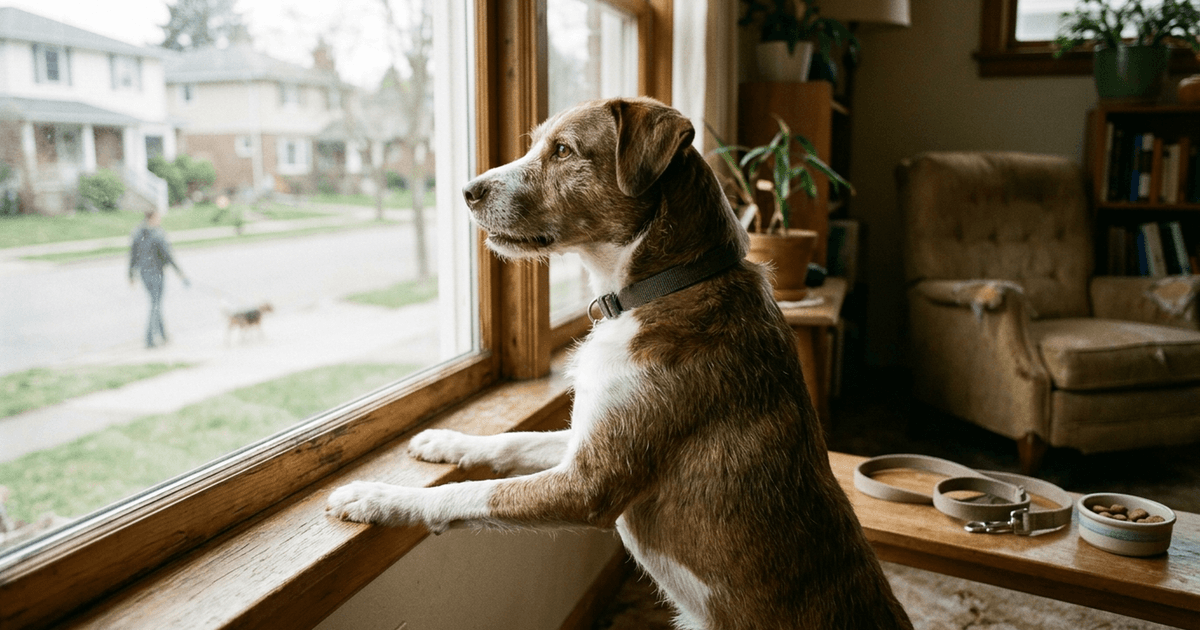
If the dog barks at every passerby through the front window, cover the window or limit access to that room. If the dog barks because the yard is a constant source of motion, block the sightline or bring the dog indoors during the worst times. If boredom is part of the problem, more activity and more mental work can help because a tired, engaged dog has less energy to spend on nuisance barking.
This kind of short-term change matters because it prevents rehearsal. Every time a dog practices barking, the habit gets easier to repeat.
4) Use desensitization and counterconditioning for trigger-driven barking
For barking tied to fear, anxiety, or a strong emotional reaction, gradual exposure is usually the better path.
Desensitization means introducing the trigger at a level so small that the dog doesn’t react, then increasing the intensity slowly over time. Counterconditioning pairs the trigger with something the dog likes so the emotional response changes. Instead of “that sound means panic,” the dog starts to learn “that sound predicts treats.”
This part has to stay gentle. If the dog is already barking hard, you’re probably too close, too loud, or moving too fast. Backing up is not failure — it’s the point. The dog has to stay under threshold long enough to learn something new.
Picture a dog who barks at other dogs on walks. If the dog can still eat treats at a safe distance, that distance may be the right place to start. You reward calm noticing before the bark begins, then slowly close the gap only as the dog remains relaxed. That is the difference between training and just exposing the dog to stress.
When barking may need more help
Some barking is more than a training annoyance. If the dog seems intensely reactive, the barking is tied to anxiety, or the problem keeps escalating despite careful management, professional help can make the work safer and clearer.
That doesn’t mean something is “wrong” with the dog in a dramatic sense. It means the barking may be part of a bigger pattern that needs a more structured plan. A dog that barks from fear, frustration, or overstimulation may benefit from a trainer or behavior professional who can help build distance, timing, and step-by-step progress without flooding the dog.
Pain, overarousal, and other underlying issues can also complicate barking, so if the behavior changes suddenly or seems out of character, a veterinary check is worth considering.
The simplest version of the plan
If you want the shortest useful version, it looks like this:
- Figure out what sets the barking off.
- Remove or reduce the trigger where possible.
- Don’t reward barking with attention or excitement.
- Reward quiet as soon as it happens.
- Teach an alternative behavior that fits the situation.
- Use slow desensitization and counterconditioning when the barking is emotional or trigger-driven.
That approach takes more patience than shouting “quiet,” but it tends to work better because it changes the dog’s habits and feelings instead of just trying to interrupt noise.
For more on breed tendencies and everyday behavior patterns, see our dog breed guides.
FAQ
Sources
- vet.cornell.edu — Excessive barking
- American Kennel Club — Bark Control Tools to Help Stop Nuisance Barking
- American Kennel Club — Understanding and Managing Excessive Barking in Dogs
- Barking at triggers - advice needed : r/reactivedogs - RedditDog barking; why does it trigger me so much? : r/Dogfree - RedditHow do you train a reactive dog out of barking without ...reactivity - Dogtraining - RedditHow to get my dog to stop barking : r/Dogtraining - RedditMy Dog's Barking Triggers Me : r/ptsd - RedditMy dog keeps barking and growling at other dogs during our ... — owner discussion