Which Cat Breeds Like Water, and Why Are They So Different From Most Cats?
Most cats would rather keep their paws dry, but a few breeds are known for being unusually water-tolerant or even water-loving. The real story is less about a magic “water cat” gene and more about a mix of breed tendencies, coat differences, curiosity, and each cat’s own experience.
On this page
Most cats would rather keep their paws dry, but a few breeds are known for being unusually comfortable around water. The interesting part is that this isn’t a simple divide between “water cats” and “non-water cats.” Breed guides tend to point to the same few names again and again, while cat behavior experts also stress that individual personality and past experiences matter a lot.
So the short answer is this: Turkish Vans are the breed most famously linked to water, and Bengals, Maine Coons, Norwegian Forest Cats, and Turkish Angoras also show up often in breed guides as cats that may tolerate or enjoy it more than average. But no breed comes with a guarantee. A cat’s attitude toward water can be as much about the individual in front of you as the name on the pedigree.
Why most cats dislike water
Most domestic cats are not fans of water. One common explanation is history: many domestic cats descended from desert-dwelling ancestors, where large bodies of water were not part of everyday life. If a species never needed to swim, bathe, or hunt in wet conditions, there was little reason for it to develop a strong comfort with water.
There’s also the practical side. Most cat fur absorbs moisture rather than deflecting it, so getting wet can leave a cat feeling heavy, cold, and less agile. That matters because cats like control over their bodies and movements. A soaked coat is the opposite of that. It slows them down, messes with grooming, and can make even a simple escape jump feel awkward.
That doesn’t mean every cat is afraid of a sink, bath, or rainstorm. It means the average cat starts from a place of caution, and many have good reasons to stay there.
The breeds most often linked to water
Breed guides don’t all list exactly the same cats, but a strong pattern does emerge. The breeds most consistently mentioned are Turkish Van, Bengal, Maine Coon, Norwegian Forest Cat, and Turkish Angora.
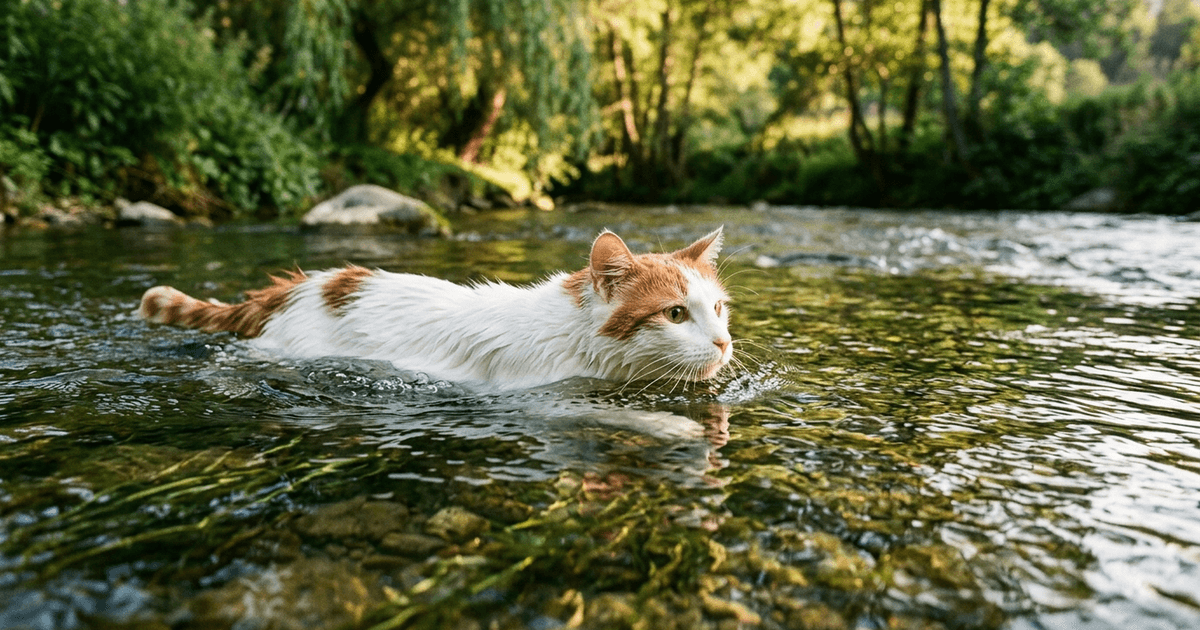
The Turkish Van is the standout. It’s often called the “swimming cat” and is native to the Lake Van region of Turkey. Breed descriptions commonly say these cats enjoy splashing, dipping their paws in bowls, or even swimming. They’re also described as having a semi-long, cashmere-soft coat that is water-resistant, which may help explain why wetness doesn’t bother them as much.
Bengals are another breed that comes up repeatedly. They’re described as highly athletic and curious, and that curiosity seems to extend to running water. A sink, faucet, or dribbling shower head can be more of a puzzle than a threat to them.
Maine Coons are often listed as water-tolerant or water-friendly too. Norwegian Forest Cats appear on similar lists, and Turkish Angoras are also commonly included among breeds that may like water more than most cats. In some guides, these breeds are connected to adapted coats, adventurous personalities, or environments that may have shaped stronger comfort with moisture.
A few other breeds appear in single sources or narrower lists, but the same five keep coming back. That consistency is useful. It doesn’t prove every cat in those breeds will love water, but it does suggest a real pattern worth noticing.
Why some breeds may be different
The most careful breed guides don’t claim there’s one tidy explanation. Instead, they suggest a mix of possible factors.
Curiosity and intelligence seem to matter. A cat that wants to investigate a dripping tap may end up spending more time around water than a cat that avoids it. Over time, repeated neutral or positive encounters can turn into comfort.
Coat type matters too. If a cat’s fur is more water-resistant, getting splashed may be less unpleasant. That alone won’t make a cat love water, but it can remove one of the biggest reasons cats dislike it.
Early exposure also shows up in the explanations. A kitten that grows up around gentle water experiences may be less likely to treat water as something alarming later on. That still doesn’t create a guarantee, but it can shape the cat’s expectations.
The other important caveat is the one people sometimes forget: breed is only a tendency, not a verdict. Catster’s coverage makes this point especially clearly, noting that water-liking behavior is usually individual and shaped by personality and past experiences. A cat with the “right” breed label may want nothing to do with a bath, while a mixed-breed cat may decide the running faucet is the greatest thing in the house.
What owners notice online versus what the sources actually show
Owner anecdotes line up with the breed guides in a few interesting ways. Reddit users often describe Turkish Vans as especially likely to enjoy water, and Maine Coons come up frequently too. Some people also mention Manx cats and orange tabbies splashing in sinks, tubs, or bowls.
Those stories are fun and useful as texture, but they’re still stories. They can’t tell you what the breed always does. They mainly reinforce the same bigger lesson: some cats are unusually comfortable around water, and even within a breed, interest varies a lot.
That distinction matters because it keeps expectations realistic. If you live with a kitten who happily bats at the faucet, that doesn’t mean you’ve discovered a universal breed trait. And if your supposed “water breed” hides at bath time, that doesn’t mean anything is wrong either.
What this means for everyday cat life
For most owners, the practical takeaway is simple: don’t assume a cat will hate water just because cats are supposed to hate water, and don’t assume a breed name tells the whole story.
If your cat seems curious about water, let that curiosity stay low-stakes. A dripping faucet, a shallow bowl, or a calm splash in the sink is very different from forcing a bath. The first can be enrichment; the second can feel like a threat.
And if your cat is one of the many who clearly dislike getting wet, that’s normal too. The goal isn’t to turn every cat into a swimmer. It’s to understand why some cats step toward water while most step away from it.
The answer, in the end, is part breed, part body, and part personality. Turkish Vans may be the best-known water lovers, Bengals and Maine Coons often show up in the conversation, and Norwegian Forest Cats and Turkish Angoras are often mentioned too. But the most honest answer is still the least dramatic one: some cats have a stronger water tendency, and every cat gets the final say.
Related reading
FAQ
Sources
- Reddit — Are there any specific cat breeds that like water? — owner discussion