Are ‘Hypoallergenic’ Cats Really Allergy-Friendly, or Is That a Myth?
No cat breed can guarantee an allergy-free home. Some cats may be easier for particular people to live with, but the useful test is the individual cat—not a breed label alone.
On this page
“Hypoallergenic cat” sounds like a promise. In practice, it’s closer to a possibility: some cats may trigger fewer or milder symptoms for some people, but no breed is guaranteed to be safe for everyone with allergies.
That distinction matters. A breed label can help you narrow your search, but it cannot predict exactly how your immune system will respond to one particular cat.
The allergen isn’t simply cat hair
Most cat allergies are associated with Fel d 1, a protein found in materials including saliva, skin-related secretions, and dander. Cats spread saliva through their coat while grooming, and allergen-containing material can then travel on fur, dander, hands, clothing, and household surfaces.
So the hair itself is not necessarily the problem. It can act more like a carrier. A cat that sheds very little may leave fewer hairs around the house, yet still produce enough allergen to cause symptoms. Conversely, a long-haired cat is not automatically more allergenic simply because its coat is longer.
The effect on a household depends on several moving parts: the cat’s allergen production, how much material becomes dispersed, where the cat spends time, and how sensitive the person is.
Why “low-shedding” and “hairless” can mislead
Low shedding may make cleaning easier, but low shedding does not mean low allergen exposure. Fel d 1 is not confined to loose hair, and reducing visible fur does not remove the proteins associated with saliva or skin.
Hairless cats illustrate the same point. A Sphynx may not leave a conventional coat on the sofa, but hairlessness does not mean the cat lacks Fel d 1. The cat still has skin, saliva, and grooming-related secretions. Some people may find a hairless cat easier to manage; others may still react.
Coat length, texture, and shedding can influence how allergens move through a home, but none of those features provides a medical guarantee. A tidy-looking coat is not the same thing as an allergy-free cat.
What about Siberians, Russian Blues, and other popular choices?
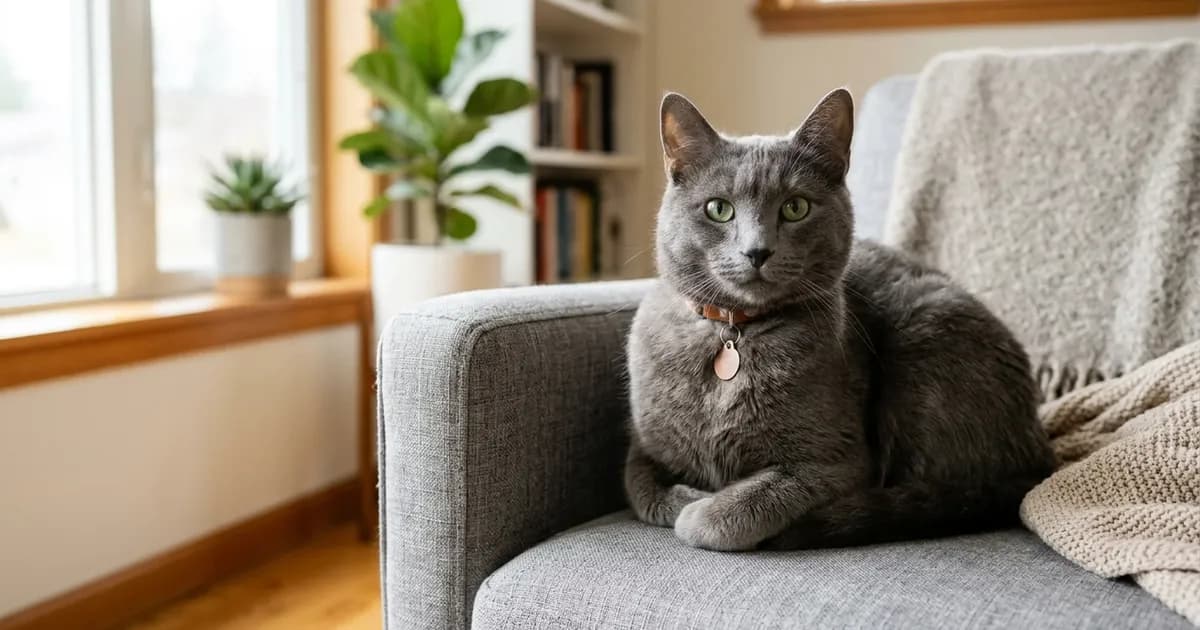
Breed guides often describe Siberians, Russian Blues, Balinese, Devon Rex, Cornish Rex, Bengal, Siamese, Oriental Shorthair, and Sphynx cats as potentially more suitable for people with allergies. The reasons offered vary: a possible difference in Fel d 1 production, less shedding, or less dander.
The Siberian receives especially strong attention because it is often believed to produce relatively little Fel d 1 despite its substantial coat. However, the supplied breed guidance also acknowledges that scientific proof for a dependable breed-wide difference is limited.
That makes these breeds worth investigating—not automatically safe. A guide can tell you why a breed is marketed as allergy-friendly; it cannot establish that every individual of that breed will suit every allergic person.
You can browse broader cat breed guides while keeping that distinction in view. Breed traits are useful for understanding temperament, grooming, and shedding, but “hypoallergenic” should be read as possibly easier for some people, not medically reliable.
The individual cat may matter more than the label
Two cats of the same breed may not affect an allergic person in exactly the same way. People also differ in their sensitivity and in the severity of their symptoms. That is why spending time with the actual cat is more informative than relying on a list of supposedly safe breeds.
A practical visit should be more than a few minutes of admiring a kitten. Spend enough time in the cat’s environment to notice whether symptoms develop, and be honest about what happens afterward. A reaction may not appear immediately, and a short visit cannot guarantee that living together will be comfortable.
An allergist can help assess the situation before adoption, particularly if allergies are severe or involve asthma or breathing symptoms. Medical advice is more useful here than a breeder’s assurance or an online ranking.
Steps that may reduce exposure at home
No household measure can promise symptom prevention, but regular cleaning and grooming are commonly suggested ways to reduce the amount of allergen in the environment.
Useful measures may include:
- Cleaning the areas where the cat spends the most time.
- Brushing regularly, with grooming handled by someone who does not react when possible.
- Paying attention to upholstered furniture, bedding, floors, and other places where dander can collect.
- Limiting access to rooms where keeping allergen levels lower matters most.
These steps address exposure after a cat comes home; they do not transform a cat into a hypoallergenic animal. If symptoms remain significant, an allergist can discuss appropriate options rather than leaving the household to experiment alone.
Readers comparing coat types may also find it useful to look at which cat breeds shed the least, especially if the main concern is hair throughout the home. Just remember that shedding and allergy risk overlap only partly.
Claims worth treating cautiously
Some online discussions go further than the evidence supports. For example, claims that Siberians have particular gene mutations causing negligible Fel d 1, or that long fur reliably traps allergens instead of dispersing them, should not be treated as established facts from the material available here.
Owner experiences can still be useful as leads. They may suggest questions to ask or breeds to meet. They cannot prove that a genetic explanation is correct, that a food or device will work, or that one person’s successful arrangement will transfer to another household.
The bottom line
Hypoallergenic cats are not allergy-free cats. Some individual cats—and perhaps some breeds—may be more manageable for particular people, but no breed label can guarantee a comfortable or symptom-free home.
If allergies matter, meet the specific cat, consider the whole household environment, and seek professional allergy guidance before making a long-term commitment. The safest decision is based on your response to that individual animal, not on the word “hypoallergenic” in an advertisement.
FAQ
Sources
- Hypoallergenic cat breeds? : r/CatAdvice - Reddit — owner discussion