Why Does My Cat Pee Outside the Litter Box but Still Poop Inside It?
A cat that poops in the litter box but pees elsewhere is giving you a useful clue, not a clear diagnosis. Medical problems, urine-specific litter-box preferences, and stress can all play a part, so veterinary evaluation should come before assuming the behavior is deliberate.
On this page
A cat that reliably poops in the litter box but urinates somewhere else can leave you wondering whether the box is the problem—or whether your cat is simply being selective. The pattern is worth noticing, but it doesn't point to one proven explanation. Using the box for stool does not rule out a urinary medical problem, and outside-the-box urine should not automatically be labeled spite, revenge, or marking.
Veterinary sources describe inappropriate urination as having several possible causes: illness, discomfort, litter-box conditions, household stress, and other behavioral changes. A veterinary examination and urine testing are sensible first steps before treating the issue as a training problem.
The medical question comes first
Urinary tract infections, bladder stones, cystitis, feline lower urinary tract disease, kidney disease, diabetes, and arthritis are among the conditions associated with changes in urination. Some illnesses increase urine production; others make urination painful or urgent. Arthritis can also make getting into or out of a box uncomfortable.
A cat may not cry or look dramatically ill. Quiet, persistent changes still deserve attention. A veterinarian may perform a physical examination and test a urine sample, sometimes alongside other tests, to look for blood, crystals, infection-related changes, or other abnormalities. The fact that bowel movements remain normal in the box doesn't provide enough information to skip that evaluation.
The exact reason a cat might separate its urine and stool habits is not established by the sources available for this article. It is reasonable to treat the split pattern as a clue that something about urination, the box, or the surrounding environment needs investigating—not as proof of a particular behavioral diagnosis.
Check for an emergency
Seek urgent veterinary help if your cat:
- Strains repeatedly but produces little or no urine
- Makes repeated unsuccessful trips to the box
- Has blood in the urine
- Shows obvious pain or vocalizes while trying to urinate
- Hides, refuses food, or becomes markedly weak
A male cat straining while producing little or no urine may have a urinary blockage, which can be life-threatening. Don't wait to see whether the problem resolves overnight.
Why the box may work for stool but not urine
The sources do not establish a single urine-versus-stool mechanism, but they do identify several practical possibilities worth checking.
Your cat may dislike something about the box specifically during urination: its cleanliness, location, litter texture, or the feeling of being exposed while using it. A box in a busy passage, near a frightening appliance, or in a place where another cat can approach may become difficult to use comfortably. A cat may still enter it for one purpose while avoiding it for another, but that explanation remains a cautious interpretation rather than a confirmed rule.
The number of boxes matters too. In a multi-cat home, conflict or competition can make access feel unsafe even when the box appears available to a person. Moving house, adding a pet, changes in routine, and tension between cats can also contribute to inappropriate urination. Marking is one possible behavior, not a synonym for every urine accident.
For a closer look at this unusual split in habits, see our guide to why a cat may use the litter box for one thing but not the other. It explores the question without assuming that every case has the same cause.
Make the setup easier to choose
While arranging veterinary care, remove avoidable obstacles rather than trying to discipline your cat.
- Scoop regularly and keep the box as clean as possible.
- Notice whether the box is enclosed, cramped, difficult to enter, or positioned where the cat may be startled.
- Consider whether a different litter texture or a recent litter change coincided with the accidents.
- In a multi-cat household, provide more than one usable location so a single cat cannot control access.
- Clean accident sites with an enzymatic cleaner to reduce lingering urine odor.
- Never punish, shout at, or physically place the cat in the box. Punishment can increase stress and does not identify the underlying cause.
A practical review of box size, placement, litter, and cleanup is available in this guide to choosing a litter-box setup that reduces accidents and odor. If you are changing litter, our comparison of litter features such as odor control, tracking, dust, and cleanup may also help you make one change at a time.
Look for patterns instead of guessing
Write down where the urine appears, how much there seems to be, whether your cat squats or sprays a vertical surface, how often the box is visited, and whether the behavior started after a household change. Note appetite, hiding, licking around the genital area, vocalizing, and any visible blood.
A short record can help the veterinarian distinguish a sudden change from a long-standing pattern and connect accidents with possible stressors. It also prevents a common trap: assuming that because the cat looks comfortable or continues to poop normally, nothing medical could be happening.
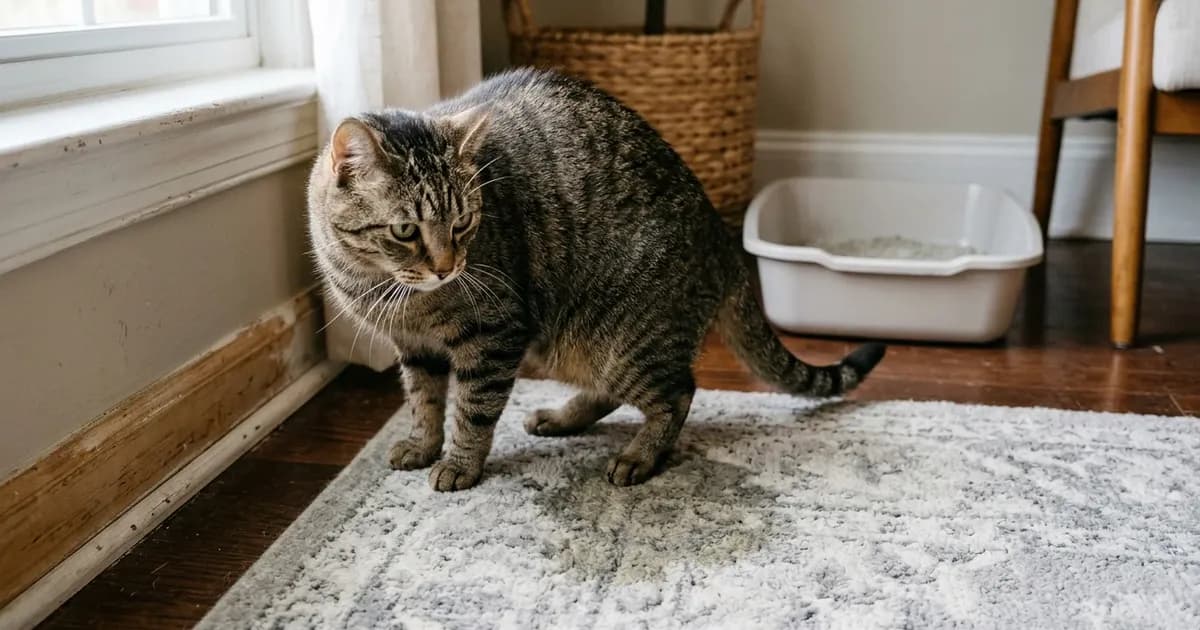
Owner forums often describe cats urinating beside apparently clean boxes or returning to rugs and other familiar surfaces. Those accounts can show how frustrating and persistent the problem may be, but they cannot diagnose your cat or show which treatment will work.
The most useful response is calm investigation: rule out urinary disease, check the box and its location, look for conflict or recent change, and clean accidents thoroughly. Your cat is communicating that urination is not working normally somewhere in the current arrangement. The message deserves curiosity rather than punishment.