How Can You Make Halloween Less Frightening for Dogs and Cats?
Halloween is easier on pets when you plan for calm, limit access to hazards, and prevent escapes before the first doorbell rings. A quiet retreat may matter more than a costume or a photograph.
On this page
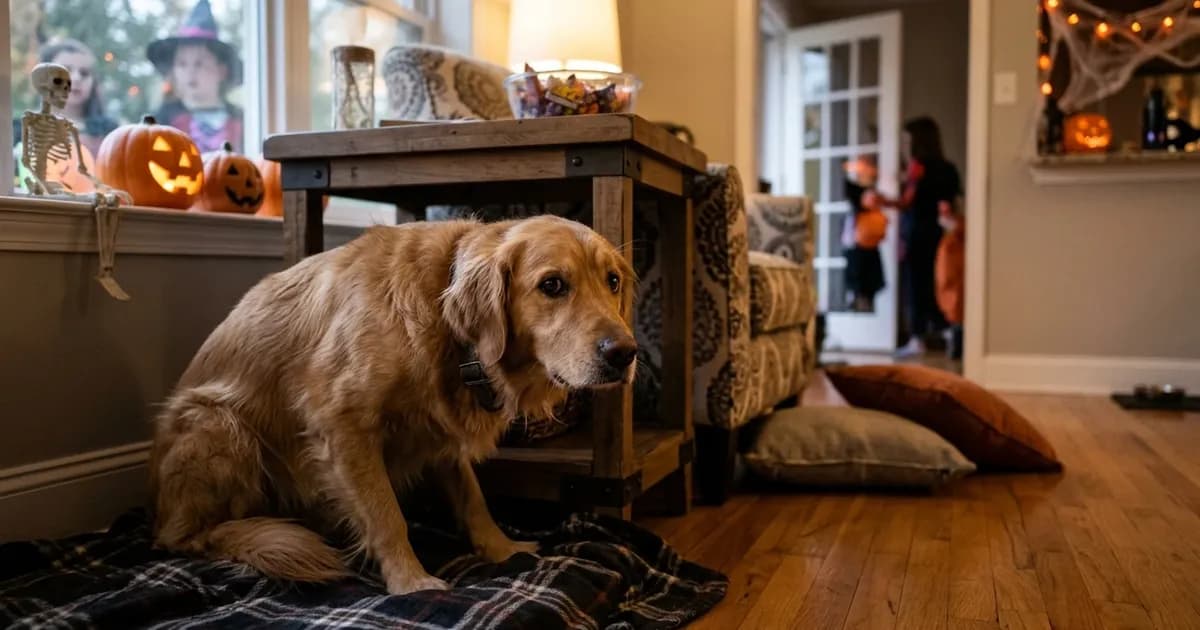
Halloween can turn an ordinary evening into a confusing parade of doorbells, unfamiliar people, strange clothing, noise, food smells, and open doors. Even a friendly, well-socialized dog or cat may become overwhelmed. The safest approach is not to involve your pet in every part of the celebration, but to give them a calm place to retreat, remove tempting hazards, and control access to the front door.
Start with a retreat, not the doorbell
Before visitors arrive, choose a quiet indoor room away from the entrance. Set it up with bedding, water, and familiar toys, then close the door before trick-or-treating begins. This gives your pet distance from repeated doorbells, costumes, voices, and the constant movement around the entryway.
A retreat works best when it is ready in advance rather than introduced during a stressful moment. Some pets may settle quickly; others may pace, hide, vocalize, or try to leave. Watch their behavior and give them the option of staying away from visitors. A dog that normally greets guests happily may not understand a child in a mask, while a cat may find the repeated opening and closing of the door especially unsettling.
For more ideas about managing visitors and decorations, see this guide to keeping dogs calm around Halloween.
Put candy somewhere pets cannot reach
Candy bowls, trick-or-treat bags, dropped wrappers, and children’s hidden stashes all deserve the same treatment: keep them out of reach. Chocolate contains theobromine, which can harm dogs and may be fatal; baking chocolate has especially high concentrations. Raisins and candies containing artificial sweeteners can also be toxic to pets.
Sugar-free products deserve particular caution around dogs because they may contain xylitol. It can appear in sugar-free gum and candy, as well as some baked goods, toothpastes, and peanut butters. Don’t assume that a small piece is harmless or wait for symptoms before seeking advice.
If your pet may have eaten chocolate, raisins, xylitol, or another potentially toxic Halloween food, contact your veterinarian or a veterinary emergency clinic promptly. Keep the packaging available so the veterinary professional can identify the product.
Decide whether a costume is worth it
A costume is optional. If your dog or cat seems uneasy, there is no benefit in pushing through for a photograph. A festive collar or a quiet celebration without clothing may be the kinder choice.
Any costume should allow normal breathing, movement, vision, and hearing. It should not interfere with barking, meowing, eating, drinking, or walking, and it should not contain small, dangling, or easily chewed pieces that could be swallowed. A costume that fits around the body can still be unsafe if it blocks the eyes, catches on furniture, or makes movement awkward.
Introduce clothing through short trial periods before Halloween. Put it on briefly, observe your pet, and remove it at the first sign of distress. Never leave a costumed pet unattended, especially when the outfit has fasteners or accessories.
Cats often prefer control over their surroundings, and a costume can make it harder for them to move or retreat. If your cat resists, hiding safely in a familiar room is a better Halloween plan than dressing up.
Make decorations boring and inaccessible
Lit candles and jack-o’-lanterns can be knocked over, creating fire or burn risks. Curious kittens are particularly vulnerable to candle flames. Battery-operated lights placed where pets cannot chew or topple them are a safer alternative to an exposed flame.
Check decorations at your pet’s level. Electrical cords can become dangerous if chewed, and dangling or sharp parts may cause injury or become tempting objects to ingest. Secure cords, remove decorations that swing within reach, and avoid placing small accessories where a pet can investigate them unsupervised.
Treat the floor and low shelves as part of your pet’s environment, not as display space. A decoration that seems harmless to an adult may look like a toy to a young dog or cat.
Control the front door
The entryway is where Halloween safety often fails. Repeated greetings create repeated chances for a pet to slip outside, especially when visitors are focused on costumes, candy, and children. Keep your pet behind a closed interior door while answering the door, and make sure household members know not to open the retreat room casually.
Supervise pets closely if they are allowed elsewhere in the house. A baby gate may help in some homes, but a fully closed door provides stronger separation from the entrance. Check that collars and visible identification tags are secure, and make sure the microchip information is current. Those details can improve the chance of a safe, fast reunion if a pet escapes.
If you take a dog outside after dark, use secure identification and keep the dog safely leashed. Halloween is not the evening to test whether a normally reliable recall can handle unusual noise and distractions.
If your pet becomes frightened
Reduce the stimulation rather than insisting on socializing. Move your pet to the prepared retreat, close the door, and keep the room quiet. Familiar bedding and toys can make the space feel less like confinement and more like a normal resting place.
Avoid forcing a frightened dog or cat to meet visitors. Give them time to settle, and monitor them without repeatedly interrupting their hiding place. If fear is severe, continues beyond the evening, or raises health concerns, contact your veterinarian for guidance. Related behavior questions may also fit naturally alongside broader pet health guides.
Should your pet get out, act quickly but calmly: secure other doors, ask visitors to pause, and search the immediate area while using familiar cues. Identification and a microchip are especially valuable at this point, but prevention remains easier than recovery.
Halloween does not have to be a performance your pet joins. For some animals, the best celebration is a quiet room, a familiar toy, and an evening without surprises. Their comfort is a more useful measure of success than whether they appear in a costume photograph.