
Why Does My Cat Lick You, Then Suddenly Bite?
A cat that licks you and then bites isn't necessarily being affectionate one moment and aggressive the next. The meaning depends on the bite itself, the interaction leading up to it, and the body-language signals your cat gives before making contact.
On this page
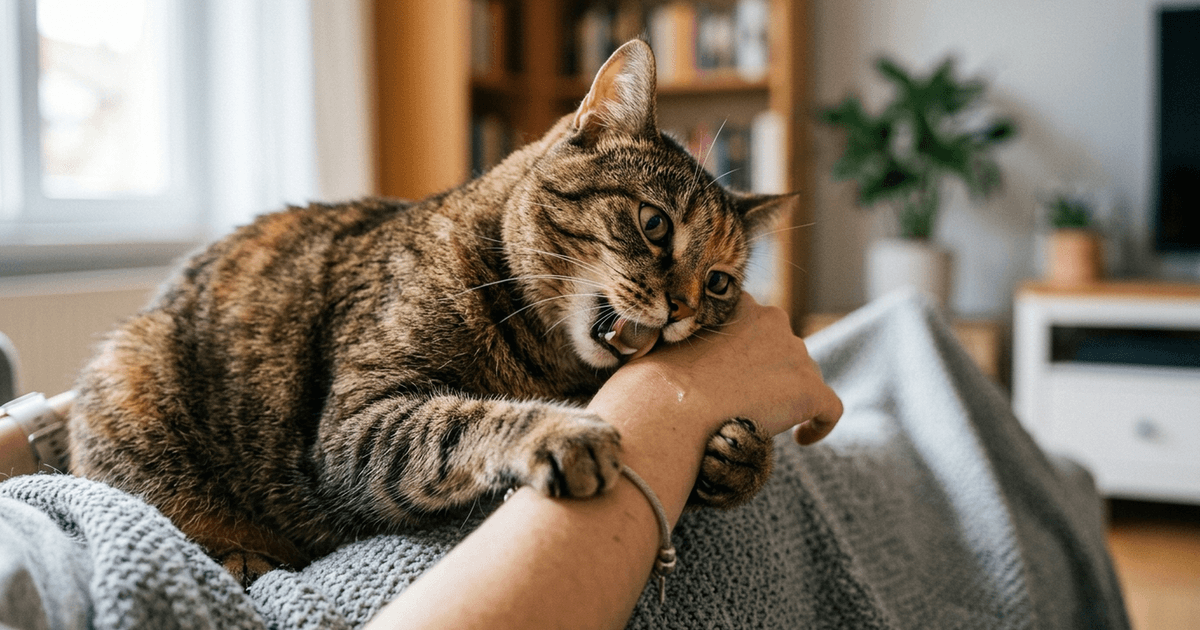
A lick followed by a bite can feel like a mixed message, but cats aren't necessarily changing from loving to angry in a single second. Licking and biting can belong to different parts of the same interaction: licking may be social grooming or exploration, while the bite may signal gentle contact, rising excitement, or a wish for the interaction to stop.
The most useful clues are the bite's intensity, what was happening just beforehand, and your cat's body language. A soft, brief nip during relaxed contact means something different from a painful bite accompanied by a lashing tail and flattened ears.
Start with the bite itself
A gentle bite that doesn't hurt may be an extension of social grooming. Cats sometimes use licking and mild mouthing in relationships with other cats, and a person may become part of that social routine. Some cats also investigate the taste, texture, or movement of a hand with their mouths. Exploration and sensory stimulation are possible contributors to the lick-then-bite pattern.
That doesn't make every gentle bite a declaration of affection. A cat can be relaxed and interested while still deciding that the interaction has become too much. Purring or seeking contact doesn't prove that a bite will be harmless; the behavior has to be read as a sequence rather than assigned one fixed meaning.
A painful bite deserves a different response. It may reflect overstimulation, irritation, anxiety, environmental stress, or discomfort with the way the cat is being handled. The available evidence doesn't establish one universal cause, so avoid assuming that every bite is either aggression or a love bite.
How petting can tip into overstimulation
Some cats enjoy being petted and then reach a tolerance limit. Repetitive handling can contribute to what is often called petting-induced aggression: the cat may initially invite or accept contact, then nip or bite when the sensation becomes irritating or overwhelming. The change can seem sudden to a person, but cats often give small warnings first.
Look for a shift in the whole body, not just the mouth. Tail swishing or flicking, flattened or rotating ears, restlessness, a quick turn of the head toward your hand, tense muscles, and enlarged pupils can all signal rising arousal or discomfort.
A cat may also stop enjoying the interaction without becoming generally hostile. It might freeze, move away, stare at your hand, or begin vocalizing more. These details matter because they give you a chance to end the contact before the bite. Tail movement that becomes sharper or more forceful is especially worth treating as a request for space.
What to do when your cat licks, then bites
The safest response is calm and uneventful. Don't punish, shout, hold the cat in place, or continue petting to test whether it will bite again. Physical punishment and restraint can add fear or conflict to an interaction that was already becoming uncomfortable.
- Stop moving your hand when you notice warning signals. Continuing to stroke, even gently, can push the cat past its limit.
- Withdraw without jerking away or making a game of the bite. Sudden movement may keep the interaction exciting.
- Give your cat space and let it decide whether to return. A pause is more useful than trying to repair the moment with more touching.
- Notice the pattern. Record what happened before the bite: where you touched the cat, how long the interaction lasted, and which signals appeared first.
Over time, this observation can reveal a practical boundary. Perhaps your cat welcomes a few strokes but dislikes prolonged handling, or enjoys contact in one context but becomes tense when tired, excited, or surrounded by environmental stress. Ending the interaction at the first warning signal teaches the cat that its communication works.
Kittens and hand-biting
Kittens often direct licking, biting, and clawing toward human hands, and owners commonly describe this happening during purring, cuddling, or attention-seeking. Those reports help show how common and confusing the pattern can be, but they don't establish one explanation for every kitten.
A kitten's small bite may be exploratory or part of an excitable interaction, while a harder bite still needs a clear boundary. Hands are poor targets for repeated biting because they are attached to the person and can make future handling more difficult. Redirecting a kitten toward an appropriate toy is frequently suggested by owners, but that suggestion is forum advice rather than independently verified evidence. Whatever approach you use, avoid turning your fingers into a moving play object.
The hunting-practice explanation sometimes offered in owner discussions should also be treated cautiously. It is not established by the evidence available here, so it shouldn't be presented as the definitive reason a kitten licks and bites.
When a change deserves professional guidance
A lick-then-bite episode that is mild, predictable, and linked to a clear interaction may be manageable through closer observation and earlier pauses. A sudden change, increasingly hard or frequent bites, or biting that occurs without an obvious handling context is harder to interpret from behavior alone.
Pain and illness can alter how a cat responds to touch, and the supplied evidence doesn't provide a reliable bite threshold for deciding when veterinary evaluation is required. Contact a veterinarian when the behavior is new, escalating, difficult to predict, or accompanied by other concerning changes. A professional can help consider medical and behavioral possibilities rather than treating the bite as a simple personality quirk.
The central lesson is straightforward: don't interpret the lick in isolation, and don't label the bite before looking at the sequence. A soft nip may be part of social contact or exploration. A painful bite after a swishing tail, flattened ears, and tense body is a request to stop. Respecting that request—quietly, early, and consistently—is the response most likely to keep future interactions calmer.