Why Does My Cat Want to Be in the Same Room but Not Be Held?
A cat can want your company without wanting to be picked up. Nearby-but-not-touching behavior often reflects a preference for companionship with control over physical contact—not necessarily rejection.
On this page
A cat can choose your company without choosing your arms. Sitting across the room, settling in a doorway, or following you from one part of the house to another may be your cat's way of joining household life while keeping control over physical contact.
That kind of parallel companionship is easy to misread. People often expect affection to look like a lap, a cuddle, or a cat that relaxes happily when lifted. But cats vary widely in how they express attachment. Some seek frequent touch; others are content to rest nearby, watch what you're doing, and approach only when interaction suits them. The supplied sources describe nearby-but-not-touching behavior as potentially consistent with trust and attachment, although they don't provide strong primary research or veterinary evidence to prove what any individual cat feels.
Your cat may want proximity, not handling
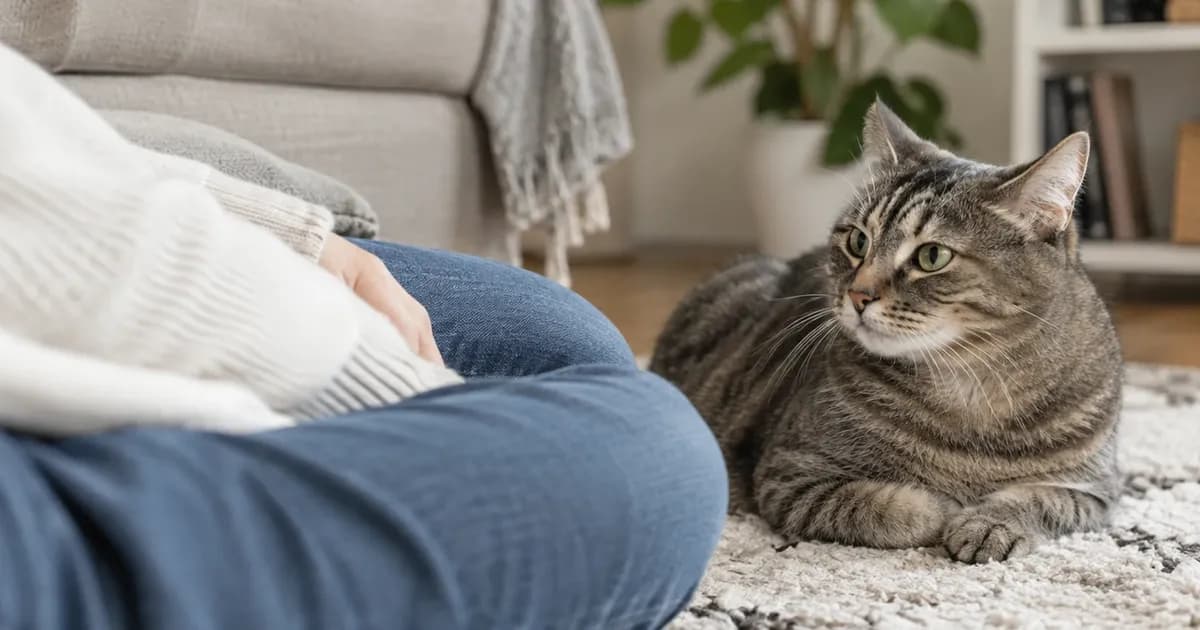
Being in the same room allows a cat to participate in your routine without giving up control of its body. Your cat might nap on a chair while you work, sit near the kitchen while you prepare dinner, or appear in the doorway whenever you move to another room. These choices show a willingness to remain close, but they don't automatically mean the cat wants to be stroked or picked up.
Physical distance isn't a reliable measure of emotional distance. A cat that consistently chooses the same room may value your presence while preferring an interaction that stays quiet and predictable. The behavior can be especially easy to overlook because it doesn't demand anything from you. Your cat may simply want to share the space.
Some cats also become uncomfortable with extended or unexpected touching. The supplied material describes touch sensitivity and possible overstimulation as reasons a cat may prefer proximity over handling. A cat can enjoy a short cheek rub, then decide that more contact is too much. Being held removes the option to leave, which can make an otherwise friendly interaction feel different from approaching you freely.
Personality, age, health, and environment can all affect how a cat responds to contact and displays attachment. A confident, outgoing cat and a cautious, easily overwhelmed cat may both be bonded to their person while behaving very differently around hands and laps.
Read the whole pattern, not one behavior
Proximity becomes more informative when you consider what accompanies it. The supplied sources mention several behaviors that may occur alongside a cat's preference to stay nearby:
- Following you from room to room or settling in a doorway.
- Resting in the same room, even without touching you.
- Slow blinking while looking toward you.
- Bringing a toy nearby, which may be an invitation to interact.
- Choosing to remain part of your daily routine without asking to be held.
None of these behaviors proves a particular emotional state on its own. A cat may sit in a room because it is comfortable there, interested in what you're doing, or simply following a familiar routine. Context matters. Look at the cat's body language, its usual temperament, and whether the behavior is stable over time.
A relaxed cat may choose a nearby spot and remain there without repeatedly trying to escape. A cat that is uncomfortable with contact may show clearer requests for space, such as moving away, resisting being lifted, or becoming tense during handling. Respecting those signals is more useful than trying to make the cat perform affection in a human form.
This is also why a cat that follows you to an apparently private place may still refuse to be picked up. The desire may be for company rather than restraint. Our guide to why cats follow you to the bathroom and then refuse to be held explores that related pattern in more detail.
How to respond when your cat stays close but avoids your arms
Treat the nearby presence as an invitation to share space, not as a request to close the distance. Sit quietly, speak gently, or offer play without reaching immediately for the cat. A wand toy, a toy placed nearby, or a brief interaction that ends before the cat becomes uncomfortable can give your cat a way to connect while retaining control.
Let the cat initiate more contact when possible. If it approaches, offer a hand for investigation rather than immediately lifting it. A short stroke may be welcome; stopping while the cat is still relaxed helps preserve the interaction as something predictable rather than something it must escape.
Avoid turning every approach into an attempt to pick the cat up. A cat that learns that coming near always leads to restraint may begin to keep more distance. The supplied sources caution against forcing affection, while owner discussions similarly describe the value of respecting individual touch preferences; those forum accounts are personal experiences, not medical or scientific proof.
Try to notice what kind of interaction your cat actually seeks. It may prefer play, conversation, a shared nap across the room, or a predictable evening routine. If you're learning to interpret everyday feline behavior, the site's cat care guides offer related reading without assuming that every cat communicates in the same way.
When avoidance is a change
A cat that has always disliked being held may simply have a stable preference. A sudden change is different. If your cat previously accepted touch and now avoids handling, or if the change persists alongside other concerning behavior, arrange a veterinary assessment rather than assuming the cat has become distant or temperamental.
The supplied sources don't explain sudden touch avoidance well enough to identify its cause. A veterinarian can help assess a change in behavior, particularly when the cat also seems generally withdrawn or reacts unusually to contact. The point isn't to diagnose the behavior from a distance; it's to avoid treating a new pattern as a personality trait before possible health or environmental factors have been considered.
For everyday questions about behavior and routine, such as changes around eating or litter-box habits, the related cat care section can help you find a more focused guide.
The companionship your cat is offering
Your cat may be saying, in its own understated way, “I want to be where you are,” without saying, “Please pick me up.” Those are separate preferences. Nearby companionship can be meaningful, but proximity alone cannot establish exactly what a cat feels, and the supplied articles are lower-tier sources rather than independent behavioral research.
A better response is to accept the form of contact your cat is offering. Share the room. Notice the slow blink. Toss the toy. Allow the cat to leave. Affection doesn't have to involve holding to be real, and trust is better supported by giving an animal control over whether physical contact continues.
FAQ
Sources
- Anyone else's cat wants to be near you, but not ... - Reddit — owner discussion