Why Does Your Cat Scratch the Sofa When a Scratching Post Is Right Beside It?
A scratching post can be inches from the sofa and still lose the contest. Cats choose scratching spots for a combination of texture, stability, body position, routine, and social importance—not distance alone.
On this page
A scratching post beside the sofa seems like an obvious substitute. Yet your cat may walk past it, stretch against the upholstery, and return to the same corner as though the post isn't there.
That doesn't necessarily mean your cat is being stubborn. The sofa may simply offer a better match. Cats choose scratching places according to several details at once: the surface, the angle, the resistance, the post's stability, the room's layout, and what usually happens around that spot. A nearby post can fail on any one of those points.
Scratching is normal cat behavior
Scratching helps cats remove the outer layer of their claws, stretch their shoulders and backs, and get physical activity. It also leaves a visible mark and a scent signal from glands in the paws. In that sense, a sofa can serve as both exercise equipment and a message board.
The behavior may become more noticeable after changes at home, including new pets, visitors, or rearranged furniture. Scratching is not simply a cat trying to damage something. The useful goal is to redirect the behavior, not eliminate it.
For a broader collection of practical advice, you can browse dogacat.com's cat care guides.
Why the sofa may win
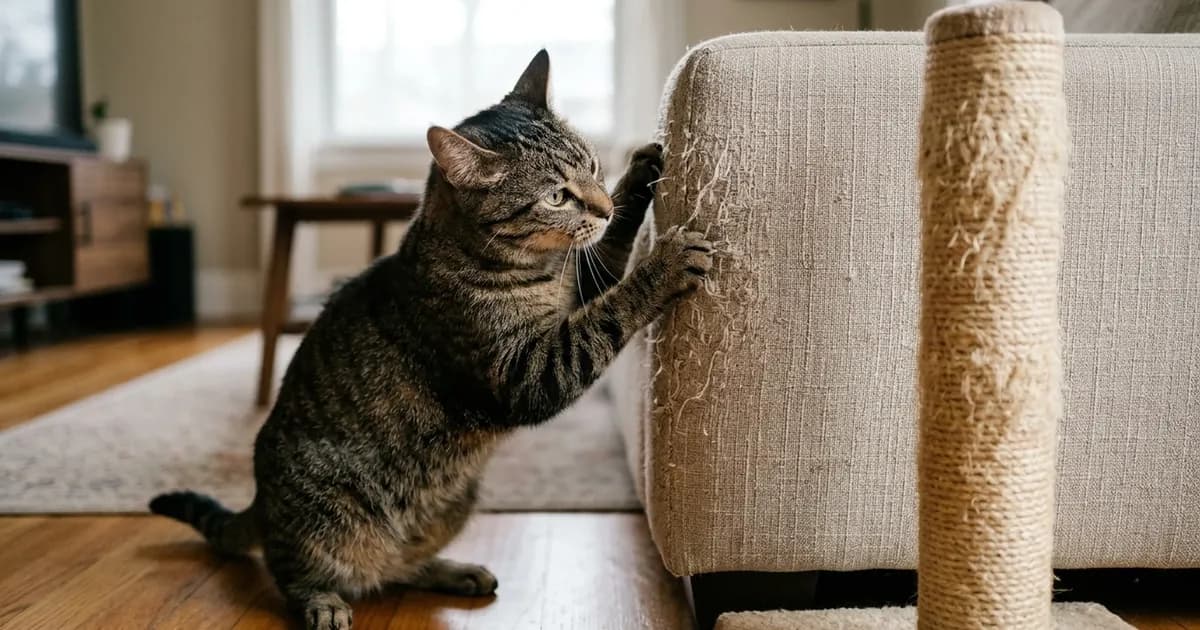
Distance is only one part of the comparison. Picture a sofa arm that is tall, firm, covered in a satisfying fabric, and positioned in the middle of family life. The scratching post beside it might be short, wobbly, tucked behind a chair, or wrapped in a texture your cat doesn't enjoy.
The sofa may offer:
- A familiar texture. Cats can differ widely. One may prefer coarse sisal, another corrugated cardboard, another upholstery, carpet, or wood-like surfaces.
- The right resistance. Upholstery may give the claws a particular amount of grip and pull. A post that feels too soft, too slippery, or too loose may be less rewarding.
- A useful angle. Some cats reach upward while others scratch across a floor-level surface. The post may be vertical when your cat wants horizontal movement—or the reverse.
- Better stability. A surface that shifts under the paws can make a full stretch uncomfortable. A sturdy sofa feels dependable.
- A larger working area. Your cat may want enough room to extend the body, not just a narrow scratching strip.
- A socially important location. Cats may scratch in living rooms, near sleeping areas, near doorways, or beside furniture where people spend time. The sofa may be part of the cat's normal routine, while the post is merely nearby.
Research supplied for this article does not establish that every cat prefers one universal material or orientation. Treat the post as a design that needs testing, not as a guaranteed solution.
Compare the sofa and the post one feature at a time
Start by watching what your cat actually does. Does the cat scratch the sofa upright, along the arm, or across the front? Does the body stretch high, or does the cat crouch and rake at the lower fabric? Notice the exact area rather than describing the habit simply as “scratching the couch.”
Then change one variable at a time:
- Match the orientation. Put a vertical scratcher beside a vertical sofa target, or add a horizontal pad for a cat that works along the floor or sofa base.
- Test the material. Try cardboard, sisal, wood-textured surfaces, and—carefully—other fabrics. Carpet may attract some cats, but it can make it harder to teach the difference between an approved scratcher and household rugs.
- Check the height and size. The scratcher should allow the cat to use the body position already seen at the sofa.
- Improve stability. Anchor or replace a post that rocks when the cat presses into it.
- Move it into the routine. Place it directly beside the targeted sofa area first. Other useful locations include near sleeping places and in social rooms where people gather.
Give each adjustment enough time to reveal whether it helps, while avoiding a pile of simultaneous changes that makes the result impossible to interpret. A cat that ignores one post may use a different combination of height, angle, texture, and location.
Make the sofa less rewarding while the new habit develops
A replacement works better when the original target is temporarily less pleasant to scratch. Furniture covers, double-sided tape, and aluminum foil are suggested temporary options. Use them to protect the problem area while keeping the approved surface immediately available.
The protection should not turn into a punishment campaign. Calmly interrupting access and redirecting the cat is more useful than frightening or scolding them. The point is to remove the easy payoff from the sofa and make the alternative simple to choose.
You can also place the scratcher so it overlaps the cat's established route or target at first. Once the cat uses it reliably, it may be possible to move it gradually. A post hidden in an inconvenient corner may be attractive to people but irrelevant to the cat.
Reward the choice you want
Whenever your cat uses the scratcher, offer praise, a treat, or playtime soon afterward. Timing matters: the reward should follow the appropriate scratching behavior, so the cat can connect the surface with something worthwhile.
Avoid dragging the cat's paws across the post or forcing a scratching motion. Instead, make the object inviting through placement and gentle encouragement. A toy or other familiar prompt may help draw attention to it, but the cat should be free to decide whether to use the surface.
If the sofa scratching happens during busy household moments, attention may be part of the pattern for that individual cat, but a single owner's interpretation cannot establish the cause. Look at the whole situation: time of day, recent household changes, where people are sitting, and which scratching surfaces are available.
What not to assume
A post's location beside the sofa does not prove that the cat has rejected training. It may be the wrong texture, too unstable, poorly shaped, or placed in a less meaningful part of the room. Nor does one successful scratcher prove that all cats will prefer that design.
The same caution applies to upholstery. Some cats may favor a particular fabric, but there is no verified universal preference for one sofa material. Observe your own cat's pattern and use it as the starting point for the replacement.
If you're noticing other selective habits around household routines, dogacat.com's guide to why a cat may use the litter box for one thing but not the other may help put that behavior in context.
When to ask for help
Persistent furniture scratching is not automatically a medical problem. However, seek veterinary advice if scratching changes suddenly alongside other concerning changes in behavior, comfort, or general health. A qualified cat behavior professional may also help when repeated changes to surfaces, placement, protection, and rewards do not make progress.
The sofa-versus-post problem usually becomes clearer once you stop treating it as a distance test. Compare what each surface offers, adjust one feature at a time, protect the sofa temporarily, and reward the cat for using the option that fits better. In many homes, the winning scratcher is not the one placed closest—it is the one that makes sense from the cat's point of view.
FAQ
Sources
- Can anything REALLY stop my cats from scratching the ... - Reddit — owner discussion