Why Do Cats Run Away From People They Seem to Like?
A cat can enjoy your company and still retreat when you stand up, reach out, or move into its space. The difference lies in how cats separate social comfort from permission for physical contact.
On this page
A cat that curls up nearby, plays with you, or gives you a slow blink may still dash away when you stand up or reach toward them. That isn't necessarily a contradiction, and it doesn't automatically mean your cat dislikes you. Cats often make a more specific judgment: I feel comfortable sharing space with this person, but I don't want that person moving into my space right now.
That distinction—between liking someone's presence and consenting to touch—explains much of this behavior.
Your cat may trust you without wanting you to approach
People often measure affection by closeness. A cat may use a different scale. Choosing to sit in the same room, resting while you're nearby, playing with you, or approaching during a quiet moment can all suggest that your presence feels acceptable or reassuring. But sitting beside you is not the same as climbing into your lap, and coming over to investigate is not an invitation to be picked up.
Approach decisions can change with the surroundings, too. Noise, movement, your posture, your tone of voice, your scent, and the cat's previous experiences may all affect whether getting closer feels safe. A person who seems harmless while sitting still can feel much less predictable when they stand, bend over, extend a hand, or walk directly toward the cat.
So the retreat may be about the approach, not a verdict on the relationship.
Why movement can change the picture
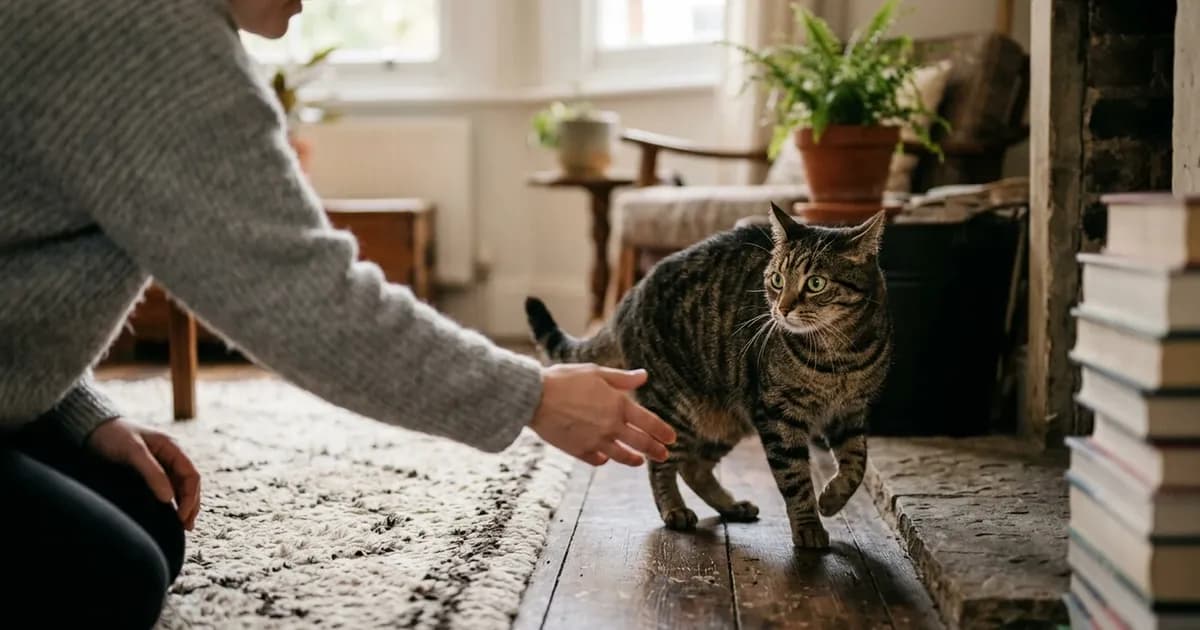
A direct approach can feel intrusive to a cat that prefers to control distance. Sudden movement may startle them, while a person leaning over or reaching from above can appear more imposing than the same person sitting quietly nearby. Even a familiar movement—such as a foot stepping forward or a hand reaching toward the head—may have become something the cat watches cautiously.
Cats can also be selective. One may welcome a hand offered at floor level but avoid a person walking toward them. Another may play enthusiastically yet dislike being touched while resting. A cat that sleeps on the bed but slips away when approached during the day is showing context-dependent comfort, not necessarily inconsistent feelings.
Personal space matters because retreat is one of the clearest ways a cat can end an interaction without escalating it. Chasing after them, blocking the exit, or continuing to reach can make the original concern stronger. Giving distance communicates that leaving works—and that the cat won't have to defend that choice.
Trust signals are not a blanket invitation to touch
Relaxed posture, soft eyes, slow blinking, and choosing to remain nearby can be encouraging signs. They tell you something about the cat's comfort in that moment. They do not guarantee that every form of contact will be welcome.
Think of these signals as an opening for observation rather than permission to proceed. A cat may slow-blink from the other side of the room but still move away when you cross the room toward them. They may rub against your legs and then object to being lifted. They may sit beside you for an hour and leave after one stroke too many.
The most useful question is not simply, “Does my cat like me?” It is, “What kind of interaction is my cat choosing right now?”
Read the whole body
No single signal explains a cat's emotional state perfectly. Purring, for example, should not be treated as proof that a cat wants more contact, and tail movement can mean different things depending on the rest of the body.
Look for a pattern instead. A cat that remains loose, keeps a relaxed posture, and chooses to stay nearby may be comfortable. A cat with flattened ears, a puffed tail, hissing, growling, a tense body, or an attempt to retreat is telling you to slow down or stop. Waiting at that point is not giving up; it's respecting useful information.
Body language is especially valuable during the few seconds after you begin moving. Does your cat stay settled when you shift position? Do they lean toward an offered hand, or turn away? Do they remain after a brief touch, or immediately create distance? Those details reveal more than the fact that they approached you earlier.
How to respond when your cat backs away
The most trust-building response is often the least dramatic one: stop moving toward the cat and let the distance remain available. Avoid following, cornering, picking them up, or repeatedly trying to “prove” that your intentions are friendly.
Try this instead:
- Sit or crouch rather than standing over the cat.
- Turn slightly to the side and keep your movements slow.
- Speak quietly, or simply remain still.
- Let the cat decide whether to come closer.
- Offer a hand for investigation without pushing it into the cat's face.
- If the cat initiates contact, begin with brief, gentle touch and pause to see whether they choose more.
- Stop when the body becomes tense, the ears flatten, or the cat starts to withdraw.
Short, uneventful interactions can do more for trust than one enthusiastic attempt at cuddling. Predictability gives a cautious cat a reason to believe that approaching you will not lead to unwanted handling.
Build closeness without chasing it
Spend time in the same room without making every quiet moment a request for contact. Calm conversation, play, or treats offered without forcing the cat closer can help create positive associations. The goal is not to lure the cat into a situation where contact becomes unavoidable; it's to make voluntary approaches feel safe.
A cat may eventually become more comfortable with touch, but progress is better judged by choice than by distance. Does your cat return after walking away? Do they approach more often during calm periods? Do they stay relaxed when you move? Those changes matter because they show growing control and confidence.
You may also find that your cat is affectionate in one way and reserved in another. Some cats prefer proximity without handling. Others like brief head scratches but dislike being stroked along the body. A guide to why cats can act clingy and then pull away may help put that push-pull pattern in context.
When the reaction is tied to one movement or situation
Pay attention if your cat reacts to a particular body part, sound, room, or time of day. The trigger might be a reaching hand, a foot moving toward them, a loud voice, or an approach while they are eating or resting. You don't need to guess the cat's entire history to respect the pattern. Simply make the triggering interaction less direct and give the cat more control.
Change one thing at a time: approach from the side, move more slowly, sit farther away, or pause before offering contact. If the cat remains tense, go back to quiet shared space and try again another time. Persistent fear, a sudden change from the cat's normal behavior, or avoidance accompanied by other concerning signs deserves a conversation with a veterinarian rather than a home diagnosis.
A cat running away is communication. It may mean, “Not that movement,” “Not right now,” or “Please give me room.” It does not, by itself, settle the question of affection. Respecting the message can be the very thing that makes your cat more willing to come back.
For more practical guidance, explore the broader cat care guides.
FAQ
Sources
- Build back trust with cat : r/CatAdvice - Reddit — owner discussion