Why Are Turkey Bones, Skin, and Gravy Riskier Than Plain Turkey for Pets?
Plain, boneless turkey can be easier to assess than a plate of Thanksgiving leftovers, but storage and preparation still matter. Here’s how cooking, fat, seasoning, gravy, and bones add separate questions to a pet’s treat.
On this page
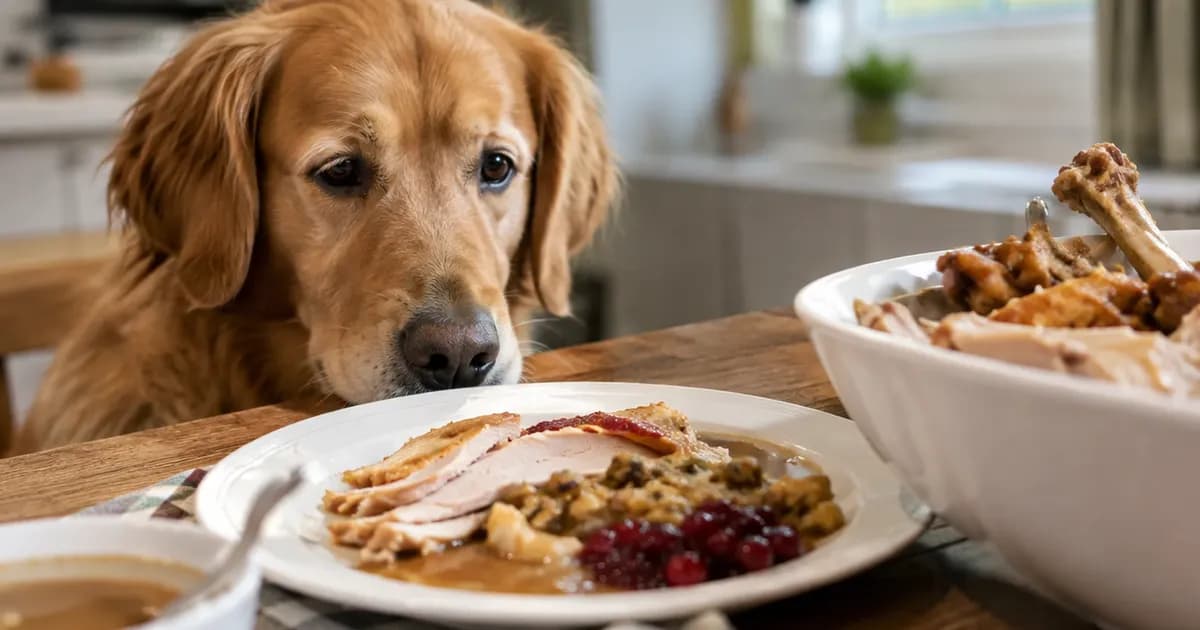
Plain, properly handled turkey is easier to assess than most Thanksgiving leftovers because it is close to a single ingredient: cooked meat without a sauce, stuffing, or visible bone. Skin, gravy, seasoning, fatty drippings, and mixed dishes add extra variables. Bones add a different concern altogether because they are not food in the same form as boneless meat.
That doesn’t mean every bite of skin or gravy automatically causes a problem, or that plain turkey is risk-free. The available veterinary evidence here does not establish specific claims about turkey skin, fat, seasoning, gravy, sauces, or cooked bones for dogs and cats. A careful owner should separate two questions: What is in the food, and how was it stored?
Think of the leftovers as a risk ladder
At the simplest end is a small amount of plain, boneless turkey that was cooked normally and refrigerated promptly. It has relatively few ingredients to identify. Move up the ladder and the picture becomes less clear:
- Turkey with skin or fatty drippings
- Turkey rubbed or basted with seasoning
- Turkey covered in gravy or sauce
- Turkey mixed with stuffing, casseroles, or other leftovers
- Turkey served with bones
- Any leftover that sat out too long or whose storage history is unknown
The ladder isn’t a veterinary diagnosis. It’s a way to see why “turkey” and “Thanksgiving leftovers” are not always the same thing. A plain piece of meat lets you ask a fairly direct question. A spoonful of casserole may contain several ingredients, and you may not know how long it spent cooling on the table.
For a broader guide to holiday ingredients, see which Thanksgiving foods cats and dogs can share.
Storage changes the question completely
Even food that began as plain turkey can become a food-safety problem if it was left at room temperature too long. Perishable Thanksgiving leftovers should be refrigerated within two hours of coming out of the oven or refrigerator. The cited food-safety guidance places the danger zone between 40°F and 140°F, where bacteria can multiply quickly.
Refrigeration does not reset the clock. Food left out for more than two hours should be discarded rather than chilled and saved for later. That matters in a busy kitchen, where a turkey platter may remain on the table while people talk, return for seconds, and gradually lose track of time. Online discussions reflect how common that uncertainty is, particularly when dishes become lukewarm, but owner reports are not a substitute for food-safety guidance.
Once leftovers have been refrigerated promptly, the cited guidance says they should be eaten, frozen, or discarded by the Monday after Thanksgiving—the end of the four-day window. Frozen leftovers remain safe indefinitely when properly stored, although quality declines; using them within two to six months is recommended for best taste.
Reheating is not a way to rescue food that sat out too long. For leftovers that were stored correctly, reheating should bring the food to at least 165°F before it is eaten. That temperature rule applies to general leftover safety; it does not prove that every Thanksgiving ingredient is appropriate for a dog or cat.
Why skin, fat, seasoning, and gravy need separate thought
Plain turkey and turkey coated in holiday extras should not be treated as identical foods. Skin and fatty portions change what the pet is consuming, while seasoning, gravy, and sauces make the ingredient list harder to inspect. The supplied veterinary evidence does not verify specific risks for these components, so broad statements such as “turkey skin causes pancreatitis” or “all gravy is toxic” go beyond the available support.
A safer editorial and household approach is to avoid treating a mixed dish as a simple meat treat. Ask what was added, whether the pet actually ate the sauce or skin, and whether the food was stored correctly. Gravy can also spread across a meal, making it harder to tell how much of each ingredient a pet consumed. Stuffing, casseroles, and pan drippings create the same practical problem: the name of the dish tells you less than its full ingredient list and storage history.
That uncertainty is especially relevant for cats, which may take only a few bites, and dogs, which may eat a large amount quickly. The amount eaten and the animal’s health history can change how urgently a situation should be assessed. If a pet has eaten an unknown quantity of seasoned leftovers, gravy, or fatty food, contact a veterinarian for advice rather than trying to infer safety from the word “turkey.”
Bones are not just another part of the bird
A boneless piece of turkey can be evaluated as meat. A turkey bone needs a separate decision. The available sources do not provide veterinary evidence here to confirm or deny specific claims about cooked bones, including the often-repeated claim that they splinter. That claim should not be presented as verified from this research brief.
What can be said clearly is that a bone makes the exposure different from boneless turkey. It introduces a hard, non-meat object and may be difficult to account for after a pet has swallowed it. Homemade broth creates another layer of uncertainty: an owner may be considering cooked bones, scraps of meat, cooling time, and several days of storage all at once. A Reddit discussion about making broth from Thanksgiving bones illustrates that question, but it cannot establish whether the practice is safe for pets.
If a dog or cat has swallowed a bone, call a veterinarian or emergency veterinary service for individualized advice. Seek urgent help if the pet is choking, having trouble breathing, repeatedly vomiting, showing severe pain, or acting unusually weak. Do not rely on an online anecdote to decide what to do with a potentially serious ingestion.
A practical way to sort the plate
Before offering a Thanksgiving scrap, run through four questions:
- Is it plain? Boneless turkey is easier to identify than gravy-covered meat, stuffing, or casserole.
- What was added? Note skin, drippings, seasoning, sauce, and other ingredients rather than calling the whole portion “turkey.”
- How was it stored? Was it refrigerated within two hours, or did it sit out while the meal continued?
- How much and what exactly was eaten? An unknown amount, a swallowed bone, or a mixed dish deserves a veterinary call.
The two-hour, four-day, and 165°F rules help with general food safety: refrigerate promptly, discard food left out too long, use refrigerated leftovers within four days, and reheat properly stored leftovers to at least 165°F. They do not turn gravy, bones, skin, or seasoned dishes into proven pet-safe foods.
Plain turkey is therefore the easier choice not because “turkey” is automatically safe, but because fewer ingredients and fewer uncertainties are involved. Once the meat is attached to a bone, coated with skin and drippings, covered in gravy, or mixed into a dish that sat on the table, the decision requires more information. When that information is missing, a veterinarian is the right source for the pet-specific answer.
For more everyday feeding guidance, browse the dog and cat food and nutrition guides.
FAQ
Sources
- Reddit — Help! The Thanksgiving leftovers were out for 7 hours! Is ... — owner discussion