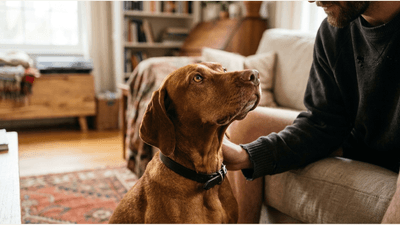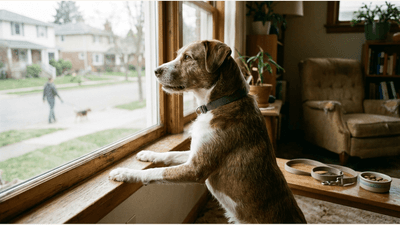
Why Do Some Dogs Seem Calm Around Cats but Struggle With Small, Fast-Moving Animals?
A dog may be perfectly composed beside a resting cat and still chase when that cat darts across the room. The difference often lies in movement, arousal, and prey-drive behavior—not a simple label such as friendly or aggressive.
On this page
A dog that lies quietly beside a resting cat may look completely trustworthy. Then the cat runs, and the dog's body changes: the stare locks on, the posture tightens, and suddenly there's a chase.
That doesn't necessarily mean the dog was pretending to be gentle. It means the situation changed. A still cat may register as a familiar household animal, while fast, erratic, or squeaky movement can activate prey-related behavior. Some dogs can share space peacefully with a cat that is sitting on a windowsill but struggle when the same cat bolts beneath a chair.
Calm around a stationary cat is useful information, but it isn't proof that movement will be safe. The more revealing question is whether the dog can notice movement, stay responsive, and disengage before chasing begins.
A resting cat and a running cat can be different triggers
Predatory behavior is often described as a sequence: orienting toward an animal, staring, stalking, chasing, grabbing or biting, and in some cases killing or consuming. Dogs don't have to show every stage. One dog may fixate and stalk; another may skip straight to pursuit.
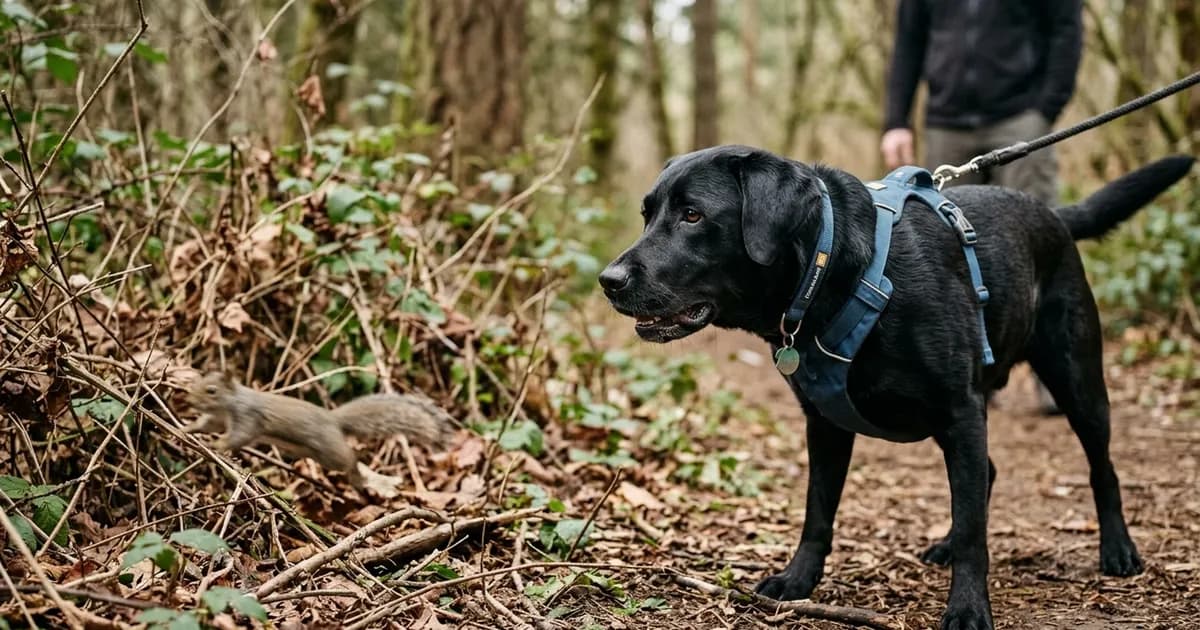
Movement can supply the spark. A cat sprinting across a room, darting under furniture, swatting, squeaking, or scrambling up stairs may be much more stimulating than a cat curled up on a sofa. Fast and unpredictable movement can intensify a dog's focus, even when the dog seemed relaxed moments earlier.
The response may also be quiet. Barking and growling are not required. A dog that freezes, closes its mouth, tracks the cat with a hard stare, lowers its body, or begins stalking may be showing more concern than a noisy dog that simply wants attention. Silent concentration can leave an owner with less warning before a chase.
For a closer look at the difference between play and pursuit, read why dogs chase cats and how to tell what the behavior means.
Prey drive is not the same thing as fear-based aggression
Prey drive refers to instinctive behavior patterns associated with hunting. It doesn't automatically mean the dog is frightened, angry, or generally aggressive toward cats. A dog may be social and affectionate in many settings while responding intensely to a small animal that moves like prey.
That distinction doesn't make the behavior harmless. A chase can end in cornering, pouncing, grabbing, pinning, snapping, or biting. A cat may also become stressed without being physically injured if it lives with a dog that repeatedly watches, pursues, or blocks its movement. Hiding more often, avoiding shared rooms, or changing normal eating, drinking, or litter-box routines can signal that the cat is not comfortable.
The dog's ability to disengage matters more than a reassuring label. Can the dog turn away when called? Can it take food, respond to a familiar cue, and relax behind a barrier? Or does the cat's movement make the dog stop listening altogether? Those observations help describe risk more accurately than saying the dog is simply “good” or “bad” with cats.
Breed history offers clues, not a verdict
Selective breeding emphasized different parts of predatory behavior in different working groups. Some dogs were bred to notice and pursue movement; others were selected for tracking, gripping, retrieving, or stopping short of contact. That history may influence how a dog responds.
Still, breed alone cannot determine whether a particular dog is safe with cats. Individual history and observed behavior carry more weight. A dog that has chased wildlife, cats, or small pets deserves extra caution, regardless of its breed label. Conversely, a breed commonly described as easygoing should not receive unsupervised access to a cat without observing how that individual behaves when movement occurs.
A dog's behavior around children, large dogs, or a motionless cat also cannot automatically predict its response to a running cat. The trigger may be the size, speed, sound, or pattern of movement rather than the social relationship in the room.
Warning signs that deserve immediate attention
Take the situation seriously if the dog:
- Fixes on the cat with a hard stare
- Becomes stiff, still, or crouched
- Tracks the cat's movement without responding to its handler
- Stalks, corners, or blocks the cat
- Chases suddenly when the cat runs
- Pounces, grabs, pins, snaps, or bites
- Repeatedly watches the cat even when nothing is happening
A dog does not need to growl for the situation to be dangerous. Nor does a single calm introduction erase a history of chasing. A dog that has injured a cat, shows persistent fixation, or has snapped or bitten should be assessed by a qualified veterinary behavior professional before owners attempt do-it-yourself training.
Making the home safer
Management comes before testing. Don't arrange a dramatic “let's see what happens” chase scenario. Every rehearsal of pursuit can make the pattern more practiced, while the cat pays the price for an inaccurate assessment.
Give the cat a genuine dog-free area with its own essentials and a way to leave quickly. Elevated spaces, escape routes, secure barriers, and rooms the dog cannot enter allow the cat to move without being cornered. During introductions or training, keep the dog physically controlled and supervise closely. Some pairings may improve with careful work but still never become safe for unsupervised contact.
A gradual desensitization and counterconditioning plan can help in appropriate cases. The dog sees the cat at a distance or through a barrier, remains below the point where fixation takes over, and receives valuable rewards for calm attention and disengagement. Exposure should be controlled rather than forced. If the dog stops taking food, stiffens, lunges, or cannot respond, the setup is too difficult and the animals should be separated.
Punishment-based methods such as shock collars or “alpha rolls” are not recommended for this problem. They may suppress visible behavior without making the dog genuinely comfortable or reliably safe around a moving cat. A veterinarian or qualified behavior professional can help decide whether the dog is a reasonable candidate for a structured plan and how much management will be needed.
For related practical guidance, see how to choose a dog breed for a home with cats and children and the broader dog-care guide.
The most useful conclusion is also the least dramatic: a dog can be gentle in one context and unsafe in another. Watch what happens when the cat moves, not only what happens while the cat is resting. A safe arrangement depends on the dog's ability to remain responsive, the cat's ability to escape and relax, and a management plan that does not rely on hope or a calm moment lasting forever.
FAQ
Sources
- Can a dog with a high prey drive ever live with a cat? - Reddit — owner discussion