
Why Does My Dog Follow Me Everywhere but Ignore Me When I Call?
A dog can be deeply motivated to stay near you without understanding or reliably responding to a recall cue. Following is shaped by companionship, routine, attention, and security; coming when called depends on learning history, motivation, timing, and distractions.
On this page
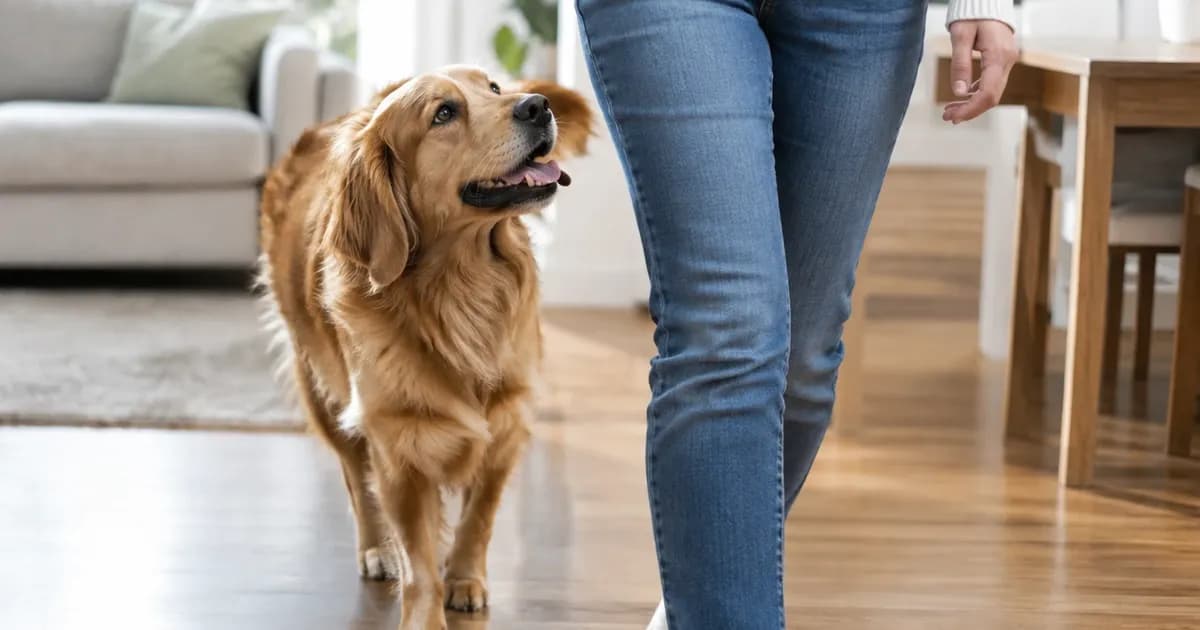
A dog can trail you from the kitchen to the bedroom and still fail to come when you call. That isn't necessarily a contradiction, and it doesn't automatically mean your dog is stubborn, dominant, or uncaring.
Following you and responding to a cue are two different behaviors. Staying close may be rewarding all by itself: your dog gets companionship, attention, reassurance, access to walks, or the chance that something interesting—and possibly tasty—will happen. Recall asks for something more specific: notice a particular cue, stop doing whatever is more appealing, and move toward you. Those skills have to be learned and reinforced in the situations where you expect them to work.
Why your dog follows you
Many dogs simply enjoy being near a person they trust. Your movements are part of the household rhythm, and following lets your dog stay involved in whatever comes next. A trip to the refrigerator, a change of room, or the sound of a leash being picked up may have become meaningful through repetition.
Following can also pay off. A dog that receives treats, affection, praise, play, or a walk after staying close may learn that shadowing its person is a useful habit. Attention and boredom can play a role too. A dog with little else to do may follow you in the hope of interaction or an unexpected activity.
Newly adopted dogs may stay especially close while they learn the household, build an attachment, and look for reassurance. In that situation, following may reflect uncertainty as much as affection. Calm body language and the ability to settle elsewhere suggest a different picture from a dog that cannot relax when you move away.
Why a dog may ignore a call while staying close
Your dog may be happy to remain near you on its own terms but have a weak history with the verbal cue. Perhaps “come” has been used inconsistently, usually followed by something the dog dislikes, or repeated several times before anything happens. Perhaps the cue works in the quiet living room but loses its pull in the yard, near other dogs, or beside an exciting smell.
Motivation changes with context. A dog already walking beside you may have no reason to respond to a call from three feet away. The same dog might also ignore you when the environment offers a stronger competing reward. That does not prove deliberate defiance; the available information does not establish that ignoring a call comes from stubbornness, dominance, lack of affection, or conscious disobedience.
Watch the difference between these two moments:
- You stand up, and your dog chooses to follow because your movement predicts interest or company.
- You give a cue while your dog is sniffing, watching another animal, or enjoying freedom, and expect an immediate change of plan.
The first behavior can be well established even when the second is not. A dog may recognize your voice perfectly and still need more practice attaching a particular word to a particular action.
Read the context, not just the result
Try comparing your dog's response in several situations. Does the dog come promptly in a quiet room but hesitate outdoors? Does it respond when you use an upbeat voice or show a reward, but not when you call from a distraction? Does it turn toward you, process the request, and then move slowly—or fail to orient at all?
Those details help identify what needs work. A cue that succeeds in one setting may not yet be reliable in another. Training generally needs to progress from easier environments toward more distracting ones, rather than jumping straight from the living room to a busy park.
Reward history matters as well. If coming to you regularly ends play, ends sniffing, or leads to an unpleasant event, the cue may lose value. By contrast, a response that consistently produces something the dog wants becomes easier to repeat. Owner discussions commonly recommend returning to simpler lure or capture exercises, practicing where distractions are low, and rewarding faster responses with especially appealing rewards. These are training suggestions from user discussions, not a substitute for professional behavioral guidance.
Repeatedly saying the cue can also make the pattern harder to read. Some owners report that a dog learns the first request is optional because several repetitions follow. A practical training approach is to avoid turning the cue into background noise: give it once when the dog has a reasonable chance of responding, then make the situation easier and rebuild the behavior if needed. If an old cue has become unreliable, some trainers and owners choose to teach a new one from the beginning rather than continuing to repeat a weakened word.
Calm companionship or anxious shadowing?
Close following is not automatically a problem. A relaxed dog may walk behind you, lie down while you work, and remain comfortable when you close a door or leave the room. In that case, the behavior may simply be part of the relationship and daily routine.
Concern rises when following is intense, sudden, or paired with signs of distress. Pacing, whining, panting, inability to settle, or visible distress when you prepare to leave can point toward anxiety or separation-related difficulty rather than ordinary companionship. Body language and timing matter: a loose, settled dog tells a different story from one that appears tense and unable to disengage.
A sudden change deserves attention, particularly if your dog has also become unusually restless or behaves differently in other parts of daily life. A veterinarian can help assess possible medical contributors, while a qualified force-free trainer or veterinary behaviorist can help with anxiety and separation-related concerns. Avoid punishing a dog for anxious behavior; punishment may add stress without teaching the calm response you want.
Helping your dog respond more reliably
Start where success is easy. Call your dog in a quiet room, use a clear cue once, and reward the response promptly. Build short repetitions into ordinary life rather than testing the dog only when you urgently need the behavior. As the response becomes consistent, add distance and mild distractions gradually.
It also helps to protect the meaning of the cue. Call when you can reward the dog or make the outcome worthwhile, not only when an enjoyable activity is about to end. If you need your dog to leave something especially interesting, improve the setup rather than repeatedly calling louder.
At home, reward independence too. When your dog chooses to rest on a bed or settle a little distance away, quietly reinforce that choice. Calm, predictable routines and rewards for relaxing away from you can support independence without treating normal companionship as a problem.
A dog that follows you but ignores a call is usually showing a mismatch between two learning histories, not revealing a contradiction in its feelings. Your dog may value your presence while still needing clearer practice, better timing, more worthwhile reinforcement, or a less distracting starting point for recall.
For more practical guidance, browse the dog care guides. If your dog's response changes dramatically around cats or other fast-moving animals, this discussion of why some dogs chase small, fast-moving animals may also help put the behavior in context.
FAQ
Sources
- DogTraining: For training and rehabilitating dogs ... - Reddit — owner discussion