What Does ‘Hypoallergenic Cat’ Really Mean if Every Cat Produces Allergens?
“Hypoallergenic” doesn’t mean allergy-free. It usually describes a hope for lower exposure or fewer symptoms, but a cat’s breed, shedding pattern, and an individual person’s reaction don’t line up neatly.
On this page
A hypoallergenic cat is not an allergy-free cat. Every cat produces allergens, so the word usually works as a relative claim: perhaps a particular cat produces less of the proteins that trigger symptoms, spreads less allergen around the home, or simply happens to be better tolerated by one person than another.
That distinction matters before anyone chooses a breed, pays a deposit, or brings a cat into a household where someone has allergies. The label can suggest lower risk. It cannot promise a reaction-free relationship.
Fel d 1 is not the same thing as cat hair
The allergen most often discussed in cat-allergy claims is Fel d 1, a protein associated with cats’ skin and saliva. Cats can distribute allergens onto their fur as they groom themselves, and allergen can then move into the home through contact with the coat, skin flakes, and surrounding surfaces. Cats’ fur can also collect other potential irritants, such as pollen and mold spores.
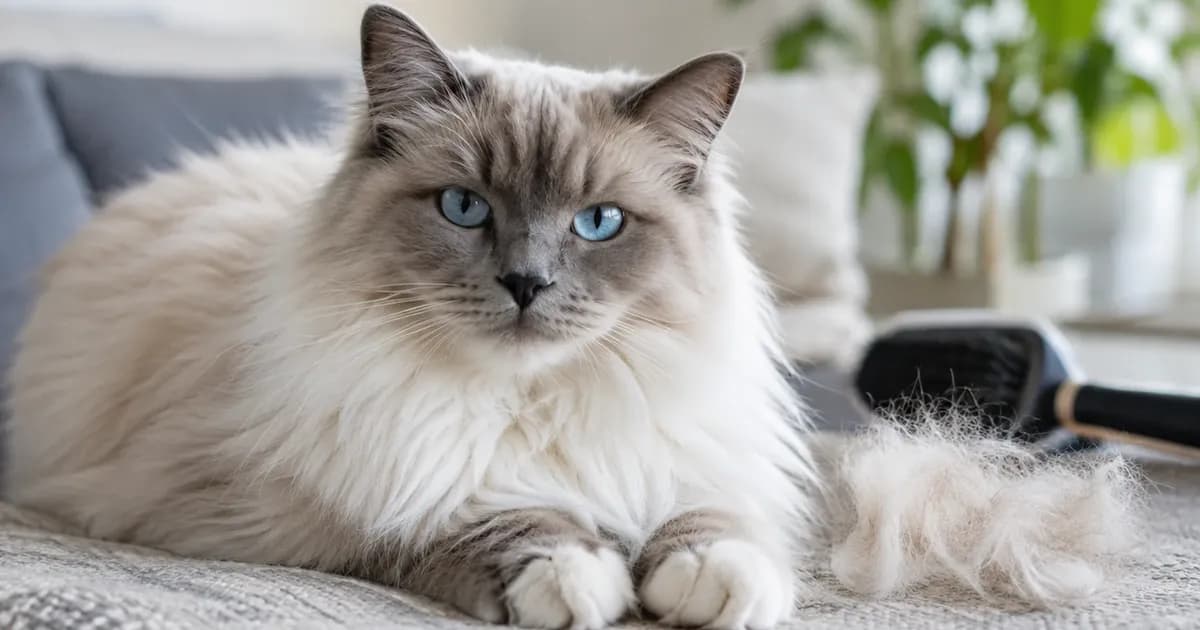
Visible hair is therefore only part of the picture—and often not the part causing the allergic reaction. A tumbleweed of fur on the sofa may be unpleasant to clean, but the allergen is a protein, not the hair itself. A hairless cat can still produce allergens, while a long-haired cat may not necessarily produce more of them.
The American College of Allergy, Asthma & Immunology states that all cats produce allergens and that studies have not established genuinely hypoallergenic cats or breeds. It also notes that fur length is not associated with a cat’s allergen level.
For a broader look at the language behind these claims, see whether “hypoallergenic” cats are really allergy-friendly.
Three variables that are easy to confuse
A realistic assessment separates three different questions:
How much allergen does this cat produce? Some discussions suggest that individual cats or certain breeds may produce lower levels of Fel d 1. The available material does not establish a breed that consistently produces negligible or absent amounts, however.
How does the allergen get distributed? Grooming, skin, fur, saliva, and contact with household surfaces all affect where allergen ends up. A cat that spends time on bedding, upholstered furniture, or clothing may bring allergen into places where people spend long periods.
How much does the cat visibly shed? Shedding affects cleaning and how much loose hair a household notices. It does not prove that the cat produces less Fel d 1, and the available material does not show that reduced shedding reliably prevents allergic reactions.
These differences explain why a low-shedding cat may still trigger symptoms—and why a person might tolerate one ordinary cat better than another. Less hair on the floor can make life tidier without changing the underlying allergy risk in a dependable way.
If loose hair is your main concern, it helps to distinguish a genuinely low-shedding breed from an individual cat that happens to shed lightly; those are not always the same thing. This guide to low-shedding breeds and light-shedding cats explores that difference.
Why breed labels are not guarantees
Breed descriptions can be useful for learning about coat type, grooming needs, and likely temperament. They are much less reliable as personal allergy forecasts.
Claims that Siberians are the only truly hypoallergenic cats, or that a particular cat has been proven not to produce Fel d 1, should be treated carefully. The supplied material contains those statements as forum claims, not as conclusions supported by authoritative evidence. A breeder may sincerely describe cats as hypoallergenic while using the word to mean “often better tolerated” or “thought to produce less allergen.” That is very different from promising that every allergic person will be symptom-free.
Even a test or claim about allergen production would not answer the whole question. Allergy symptoms depend on the exposed person as well as the cat, and people do not all respond at the same threshold. One household’s success with a Siberian, Devon Rex, Sphynx, or another breed cannot predict another person’s response.
Coat care can still matter for practical reasons. A cat that sheds less may leave fewer visible hairs and may be easier to keep off particular surfaces, but low shedding does not remove the need for grooming. Some low-shedding cats need regular care to prevent coat problems; why low-shedding cats still need grooming is worth reading before choosing one for that reason alone.
What owner stories can—and cannot—tell you
People sometimes report that an allergic friend or family member tolerated a particular cat without a noticeable reaction. Those experiences are useful in one limited way: they remind us that reactions can vary from person to person and from cat to cat.
They are not a controlled test. A short visit may involve less exposure than living with a cat, and symptoms may depend on the room, the furniture, grooming, ventilation, and other allergens present that day. Someone may also react gradually rather than immediately.
That makes an individual meeting more useful than a breed promise, but not infallible. A calm visit with a cat is encouraging; it is not a guarantee that months of shared air and household contact will feel the same.
A more realistic plan before adoption
Treat “hypoallergenic” as a risk-management description, not a biological guarantee. Before making a decision:
- Spend meaningful time with the specific cat rather than relying only on its breed label. A brief encounter may not reveal every possible response.
- Ask the breeder, rescue, or shelter what they mean by “hypoallergenic.” Find out whether they are describing coat characteristics, shedding, anecdotal tolerance, or measured allergen levels.
- Be wary of absolute promises such as “no allergies,” “allergy-proof,” or “safe for everyone with cat allergies.” The available evidence does not support those guarantees.
- Consider the whole home, not just the cat. Allergen can remain on furniture, bedding, clothing, and other surfaces.
- If symptoms are significant, persistent, or involve breathing, discuss the situation with an allergy professional before adoption. An allergist can help assess whether cats, dust mites, pollen, or another trigger may be involved.
People often focus on finding the right breed, but the safest expectation is simpler: you may be able to reduce risk, not eliminate it. A cat that sheds lightly might mean less visible cleanup. A particular individual might produce or distribute less allergen, or might simply be better tolerated by one person. None of those possibilities turns the cat into an allergen-free pet.
The bottom line
“Hypoallergenic cat” is best understood as a relative and sometimes commercial term. It may point toward lower shedding or a possibility of lower allergen exposure, but it does not mean zero Fel d 1, zero environmental allergen, or zero symptoms.
For an allergic household, the most honest approach is to combine realistic expectations with time spent around the individual cat. Choose based on the cat in front of you—not on the comforting certainty implied by a label.
FAQ
Sources
- Do hypoallergenic cats work? : r/cats - Reddit — owner discussion