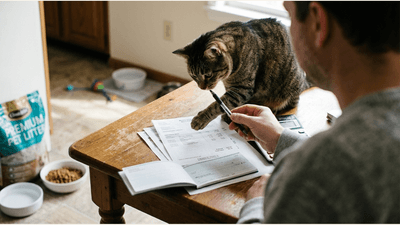
What Should a Realistic Annual Budget for a Multi-Pet Home Include?
A realistic multi-pet budget starts with each animal, not one household average. Separate recurring care, first-year setup, optional lifestyle costs, and an emergency reserve so the budget reflects how dogs and cats actually live.

On this page
A household with two dogs and a cat doesn't have one pet budget. It has three individual budgets, plus a handful of costs the animals can share.
That distinction matters because food, medication, grooming, insurance, and veterinary risk belong to each animal. A cat may need little grooming but regular litter; a large dog may eat far more and need professional care; a senior pet may need veterinary visits twice a year rather than once. A realistic plan should make room for those differences instead of multiplying a vague average.
As a broad sense check, published calculator estimates place a typical medium-sized dog's annual cost around $1,500 to $3,500 and a cat's around $1,000 to $2,500, although careful indoor-cat budgets can be lower and high-service dog care can be dramatically higher. These are estimates, not national price guarantees.
Start with one worksheet per animal
Write each pet's name at the top of a separate column or page. Record species, age, size, coat type, diet, known health needs, and the services you actually use. Then divide the expected spending into four buckets:
- Recurring care: food, treats, litter, parasite prevention, routine veterinary care, toys, bedding, and replacement supplies.
- First-year or one-time costs: adoption or purchase fees, spay or neuter, microchipping, initial equipment, and the first round of supplies.
- Optional lifestyle costs: insurance, grooming, dog walking, daycare, boarding, training, specialty diets, and convenience services.
- Emergency reserve: money set aside for illness, injury, urgent diagnostics, or treatment.
One published calculator defines total ownership cost as one-time costs plus annual costs plus variable costs. That structure is useful because the first year rarely resembles an ordinary maintenance year.
For example, one calculator illustration lists $1,560 in first-year spending, $1,160 in recurring annual costs, and $17,800 over a 15-year lifetime. Another example reaches $3,325 in the first year and $2,575 in recurring annual costs by including food, veterinary care, grooming and supplies, insurance, and walking or sitting. The figures shouldn't be treated as a quote for your pets; the useful lesson is to separate setup from ongoing care.
The recurring costs that belong in every household budget
Food is the most visible line, but it isn't the whole picture. Add treats, parasite prevention, routine veterinary care, litter for cats, toys, bedding, collars, leashes, carriers, and other supplies that need periodic replacement.
Veterinary care deserves its own line rather than being hidden inside a general “pet expenses” category. One supplied estimate puts routine wellness exams and core vaccines at roughly $300–$500 for most dogs and cats in the United States. A senior pet may need twice-yearly visits, which can roughly double routine visit costs before additional testing or treatment is considered.
A simple annual worksheet might therefore include:
- Food and treats for each animal
- Routine exams and vaccinations
- Flea, tick, heartworm, or other preventive care as recommended for that pet
- Cat litter and litter-box replacement
- Toys, bedding, bowls, carriers, collars, and leashes
- Prescription medication or supplements, when needed
- Insurance premiums, if chosen
- Grooming, walking, training, boarding, or daycare
- A separate contribution to emergency savings
A Pet Doctor Guide example divides annual spending into $360 for food, $600 for veterinary care, and $200 for other expenses. That breakdown is not a universal target, but it shows why a food-only estimate can leave a large gap.
Why dogs often create the widest range
Dogs vary considerably in food consumption, grooming needs, exercise requirements, and the amount of care their owners purchase. A large dog eating high-quality dry food may cost approximately $90–$100 per month before wet food, fresh toppers, or a prescription diet. That is already about $1,080–$1,200 a year for one food category.
Coat type changes the picture too. A short-coated dog may need little professional grooming, while a dog with a continuously growing or easily matted coat may need regular appointments. Daily daycare, dog walking, boarding, training, and travel can turn an otherwise moderate budget into a much larger one.
The supplied calculator gives one example of $2,575 in recurring annual costs: $600 for food and treats, $500 for veterinary care and prevention, $575 for grooming, toys and supplies, $600 for insurance, and $300 for walking or pet sitting. At roughly $215 a month, that example is a useful planning model—not a standard bill.
Readers comparing breeds may also find it helpful to look at a Labrador's first-year and monthly budget, since size, food intake, training, and activity can all affect the numbers.
Cats cost less in some areas, but not in every area
Routine indoor-cat care is often less expensive than dog care, particularly when there are no paid walks, daycare, or frequent grooming appointments. That does not make cats cost-free. Litter is a recurring household expense, and food preferences can change the total. Wet food, prescription diets, dental care, insurance, and treatment for illness can all matter.
A careful indoor cat may cost about $800 per year in one supplied estimate, while a giant-breed dog receiving daily daycare and insurance may exceed $25,000 per year. The enormous range is a reminder that “dog” and “cat” are not sufficient budget descriptions.
For a cat, create separate lines for litter, food, routine care, preventive treatment where appropriate, carrier and equipment replacement, dental care, insurance, and illness-related savings. Sharing a home with several cats may allow some equipment costs to overlap, but each cat still needs an individual medical reserve.
Shared household costs versus individual costs
Multi-pet homes can share some resources: a vacuum, cleaning products, grooming tools, a first-aid kit, transport equipment in some cases, and perhaps boarding arrangements. Those savings are real, but they are easy to overestimate.
Do not divide one food budget across the household unless every animal genuinely eats the same food in similar quantities. Keep these categories per pet:
- Food and treats
- Medication and preventive products
- Insurance
- Grooming appointments
- Training or behavior support
- Routine veterinary care
- Dental care
- Emergency savings
A shared category can cover household supplies, replacement cleaning tools, or common accessories. Label it clearly so shared savings do not conceal an underfunded individual need.
Treat optional lifestyle expenses honestly
Insurance, boarding, grooming, dog walking, daycare, and training are not universal expenses. For one household, dog walking is essential because of work schedules; for another, it is zero. One cat may need no professional grooming, while another may require it because of coat or health issues.
Put these expenses in a separate lifestyle bucket. That makes the core cost of care easier to see and helps you test different scenarios. The monthly insurance discussion in the supplied material gives an approximate range of $25–$60 per pet, but premiums depend on the animal, location, coverage, deductible, and policy terms.
For a closer look at the factors that push a dog's monthly bill up, see this guide to what owning a dog really costs each month.
Build an emergency reserve separately
Routine care is predictable; veterinary emergencies are not. The supplied calculator material describes emergency treatment estimates ranging from approximately $1,000 to more than $10,000, depending on the case. That is why an emergency reserve should not be treated as leftover money after food and routine visits.
One source recommends adding approximately $1,000–$3,000 per year to a dedicated emergency account. In a multi-pet home, consider the reserve at the household level while tracking each animal's health risk separately. A young, healthy cat and a senior dog do not create the same near-term planning problem.
Insurance may be part of the strategy, but it does not replace accessible savings. Policies have their own premiums, deductibles, reimbursement rules, exclusions, and claim timing. Read the terms before counting coverage as available emergency cash.
A practical example for a multi-pet home
Imagine a household with two dogs and one cat. The owners could budget in this order:
- Calculate food, routine care, prevention, litter, supplies, and medication separately for each pet.
- Add one-time costs only for the year in which they occur, such as adoption, sterilization, microchipping, and initial supplies.
- Add optional services according to actual use: perhaps grooming for one dog, walking for another, and no paid services for the cat.
- Add insurance premiums separately rather than burying them in veterinary care.
- Contribute to one emergency account while reviewing whether any pet's age or health calls for extra savings.
- Divide the annual total by 12 to create a monthly transfer, then revisit the plan after a major diet, health, or service change.
For a broader comparison of recurring and first-year categories, the site's dog cost guides provide a useful place to continue planning.
The most reliable annual budget is not the one with the most precise-looking average. It is the one that names every animal, separates predictable spending from optional choices, and leaves room for the bill that nobody hopes to receive.
FAQ
Sources
- Cost of Dog Ownership : r/ynab - Reddit — owner discussion